Posts
-
Communion Over Service
I have been rereading The Autobiography of George Müller (which I would highly recommend), and here is a quote from the book that made me reflect today:
Often the work of the Lord itself may tempt us away from communion with Him. A full schedule of preaching, counseling, and traveling can erode the strength of the mightiest servant of the Lord. Public prayer will never make up for closet communion.
As it happened, I was reading this while commuting to my church for the noon prayer set at the Prayer Room, where we gather for corporate prayer. It made me pause and ask myself: Have I prioritized quiet moments with God behind closed doors as much as the opportunities to worship and serve Him publicly?
May God continue to teach me, like Mary, to choose the better portion: to sit at His feet (Luke 10:42).
-
Prayer or Gossip
Gossiping under the guise of a prayer request. I’ve been pondering that today. When I share something as a prayer request, especially on behalf of other people, am I genuinely seeking godly counsel and prayer, or do I simply want the opportunity to talk about someone else’s situation? Have I ever used a prayer request as an excuse to share unnecessary details that are neither edifying nor mine to disclose? Have I ever used a prayer request as a channel to express my frustrations or subtly influence how others perceive the person I’m praying for?
Ephesians 4:29
Do not let any unwholesome talk come out of your mouths, but only what is helpful for building others up according to their needs, that it may benefit those who listen.
May I seek to build others up through every word that comes out of my mouth. May God continue to examine my heart and purify my motives. May I never turn something as sacred as a prayer request into an opportunity to sin with my words.
-
A Time for Everything: Winter
Today’s sermon at Church of the City was about the different seasons of life, using the changing seasons of the year as an analogy for the seasons we go through. I would like to focus on winter because I feel that it is the season I am currently in, although perhaps nearing its end, as I can already see spring approaching.
In winter, we rest and are pruned, much like a tree “rests” by entering a deep, sleep-like state during the colder months. Winter is also a good time to prune trees because it is easier to see their branching structure without the leaves getting in the way. Additionally, pruning is less stressful for a tree when it is dormant, and there are fewer pests associated with pruning cuts during this time. In this sense, winter pruning is for the good of the tree.
So, what does the Bible say about resting and being pruned?
Rest
Matthew 11:28
Come to me, all who labor and are heavy laden, and I will give you rest.
Pruning
John 15:2
Every branch in me that does not bear fruit he takes away, and every branch that does bear fruit he prunes, that it may bear more fruit.
My notes for myself are these: First, I can only find rest in God alone. Second, when God prunes me, removes something from my life, or convicts me to let go of something, I can trust that He does so because He cares for me and is at work in my life. He wants me to bear even more fruit than I am producing right now, and hence the pruning.
Therefore, it is important to receive His pruning instead of trying to resist or escape it. It is part of His work in preparing me for what comes next, just as winter prepares a tree for the growth of spring.
-
A Call to Die (Sermon Notes)
Notes from a sermon by David Nasser at Lakepointe Church, compiled from mostly direct quotes taken from different parts of the sermon.
Cultural Christianity has taken the most radical message ever preached and reduced it. We’ve simmered it down to a self-improvement program in an effort to be user-friendly. It has turned the message of the cross into upgrading life. We’ve turned Christianity into an upgrade; we’ve reduced it to self-improvement. We’ve turned it into a user-friendly message instead of a message of crucifixion. We’ve turned it into cleaning up instead of giving up our best life now, instead of the crucified life.
And when Jesus showed up 2,000 years ago, when Jesus came on the scene, He had one call. It was a call to die. And it offended religious people more than anybody else because it threatened to put them out of business. You want to really hack off people with a call-to-die message? Preach it to the church. The lost world isn’t afraid of it. They know there’s something broken. It offends the religious more than anybody else because it threatens to put them out of business.
But Jesus made it clear over and over again: Don’t add me to your agenda. Make me your life. Deny yourself, pick up the cross daily, and follow me.
The best thing I can do for myself is to get over myself. Get over my pride, my self-sufficiency, my need for control, my stubborn need to do it my way, my own selfish ambitions, my own selfish obsessions, my own need for protection, my own preferences, my tribe, my opinion, and my self-centered world.
And so we soften it, we sanitize it, we repackage it, we domesticate it, we compromise it. And frankly, we do what we can to reduce the Gospel to an accessory. It doesn’t become the mainframe; it just becomes one more add-on to everything else about who we are.
1. Get Over Yourself
The crucified life begins with this reality: It’s done. It’s finished.
Jesus gave His all, so why would He want only some of you? The audacity of a God who would want all of you is only going to make sense when you understand that. Jesus never asked any of us to do anything that He Himself didn’t model and exemplify.
Have you come to the end of yourself? Or is Jesus just an accessory? Have you brought your life to Him and said, “I am done”? The greatest thing one can do for oneself is to get over oneself.
Galatians 2:20
I have been crucified with Christ. It is no longer I who live, but Christ who lives in me. And the life I now live in the flesh I live by faith in the Son of God, who loved me and gave himself for me.
2. The Daily Death
Will you let Jesus wash your feet?
God has already washed us. That’s called salvation. Hence, we don’t need another shower, but we do need to wash our feet because our feet are going to get dirty living in this world.
The process of sanctification involves daily death.
John 13:10
Jesus said to him, ‘The one who has bathed does not need to wash, except for his feet, but is completely clean. And you are clean, but not every one of you.’
-
The Gospel Is Worth Proclaiming
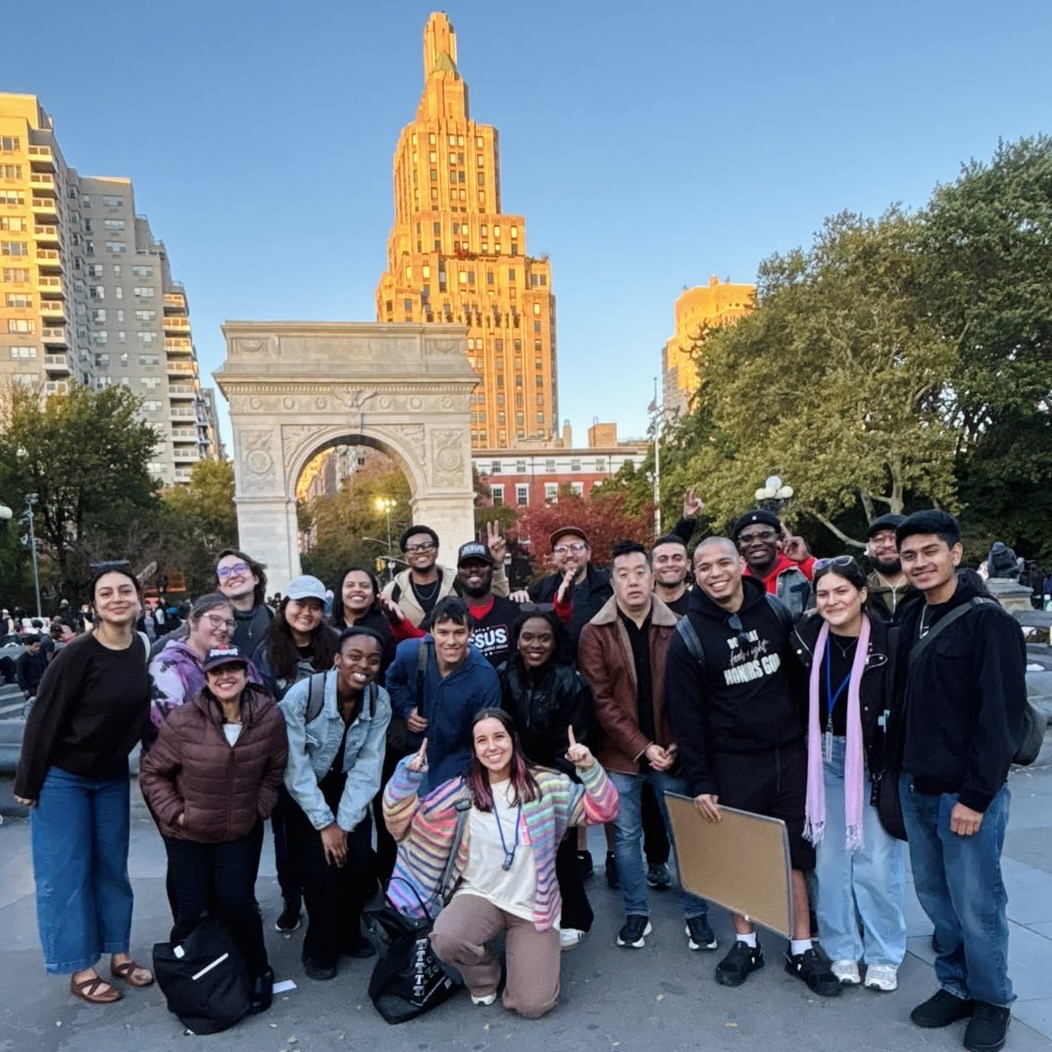
Today, I participated in an evangelism outreach organized by New York Will Be Saved at Washington Square Park. My partner for the day was Simone, who also moved to New York from Georgia earlier this year.
It’s been a little over two months since I moved to NYC, and I’m realizing more and more that it’s no coincidence I’m here. God is moving, revival is stirring, and the Christians I’ve met here are on fire! God is sending laborers to New York City!
Simone and I got to pray for a couple of people. One highlight was praying for a college student who had just moved to NYC from Dallas to study menswear design at the Fashion Institute of Technology. His prayer request was simple: safety for the community, given everything happening in the city this weekend. We prayed not only for that, but also for his studies and for him to find good friends and communities that would encourage him along the way. He gave us both a warm hug at the end.
I’m grateful for everyone we got to pray with, everyone who heard more about Jesus, the believers we had the opportunity to encourage and who encouraged us in return, and even those who rejected us.
Now that I think about it, God has really grown me in evangelism since I moved to NYC. I would say that approaching strangers in public is not something that comes naturally to me, but I do feel an increasing sense of urgency and a growing conviction of the need to share the Gospel with those who are lost. Jesus reminds us that the harvest is plentiful, but the laborers are few (Matthew 9:37).
Interestingly, I’ve also noticed a change of heart within me. In the past, especially when I was still a newer believer, I remember feeling secondhand embarrassment when I heard the Gospel being preached publicly. I don’t exactly understand why. Perhaps it was because I felt that faith should be a personal matter, something you keep to yourself. But more recently, I’ve realized that I no longer feel as ashamed of the Gospel as I once did. I’ve come to understand more deeply that the Gospel really is the power of God for salvation to everyone who believes (Romans 1:16). It is the best news, and it is worth proclaiming.
-
The Radical Forgiveness of Joseph
I just finished rereading the book of Genesis, the first book you come across when you open the Bible. It contains the story of Joseph. If you’re not familiar with his story, here’s an oversimplified version.
Joseph was the son of Jacob (who was the son of Isaac and the grandson of Abraham) and was highly favored by his father among his siblings. The favoritism, along with Joseph bluntly telling his brothers about his dreams in which they would bow down to him, fueled their resentment. Eventually, his brothers plotted to kill him but changed their minds and sold him as a slave to a group of merchants heading to Egypt. They then lied to Jacob, telling him that Joseph had been killed by a wild animal.
And somehow, Joseph ended up becoming the second most powerful man in Egypt (but not before being thrown into prison after his master’s wife falsely accused him). God revealed to Pharaoh, through dreams interpreted by Joseph, that there would be seven years of abundance followed by seven years of famine. Under Joseph’s oversight, Egypt stored 20% of its harvest during the seven years of abundance to prepare for the famine.
When the famine finally arrived and struck Canaan as well, Joseph’s brothers travelled to Egypt to buy food. Joseph recognized them, but they didn’t recognize him. He used this opportunity to test whether they had truly regretted their past actions and changed their ways before eventually revealing his identity. Rather than seeking revenge (he could have easily enslaved them or had them killed), Joseph forgave them, embraced them, and invited them to move to Egypt with their father, Jacob, and the rest of their family. He promised to provide for them during the remaining years of famine.
This whole story serves as another reminder of the radical forgiveness that I am learning to grow in. And guess what? Joseph had not one, but two opportunities to take revenge on his brothers. The first was when they came to Egypt to buy food. The second came years later, after their father, Jacob, had died. Fearing that Joseph might finally take revenge now that their father was no longer around, they offered themselves as his servants.
But once again, Joseph reassured them not to be afraid and promised to continue providing for them and their families.
There is so much to learn from this story. May God grant me a forgiving heart like Joseph’s and, most importantly, a heart that trusts that He can redeem even the sins committed against us and bring good out of evil.
Genesis 50:15–21
When Joseph’s brothers saw that their father was dead, they said, “It may be that Joseph will hate us and pay us back for all the evil that we did to him.” So they sent a message to Joseph, saying, “Your father gave this command before he died: ‘Say to Joseph, “Please forgive the transgression of your brothers and their sin, because they did evil to you.”’ And now, please forgive the transgression of the servants of the God of your father.” Joseph wept when they spoke to him. His brothers also came and fell down before him and said, “Behold, we are your servants.” But Joseph said to them, “Do not fear, for am I in the place of God? As for you, you meant evil against me, but God meant it for good, to bring it about that many people should be kept alive, as they are today. So do not fear; I will provide for you and your little ones.” Thus he comforted them and spoke kindly to them.
-
His Word Shall Not Return Empty
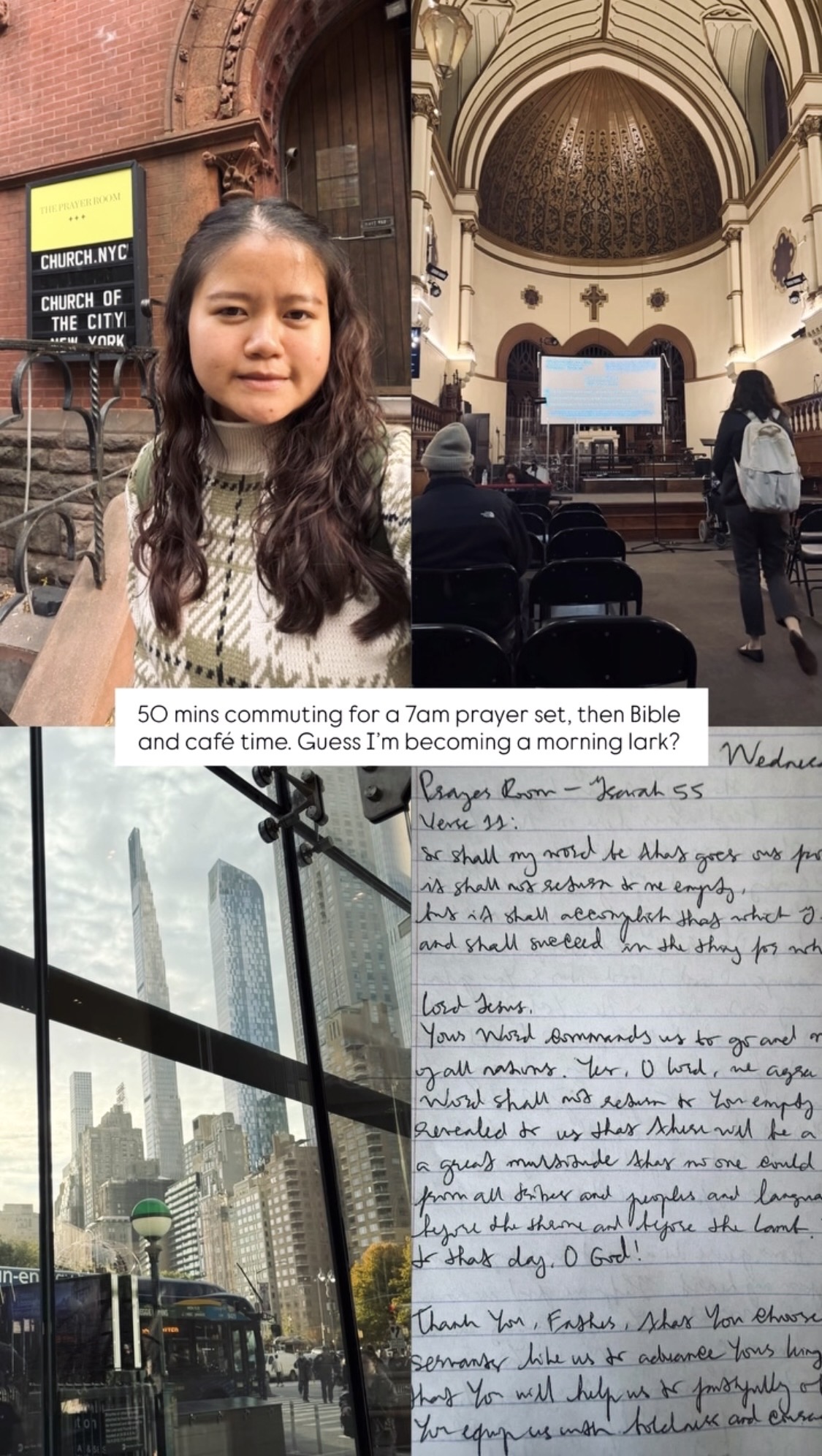
Today, I went to the morning prayer set at Church of the City for the first time (guess I’m slowly entering my morning person era, haha). I arrived around 6:45 AM, so I was able to join the latter part of the 6 AM prayer set before staying for the next one at 7 AM. Today, we meditated on Isaiah 55, and as we contended for New York City in prayer, I wrote down this prayer in my notebook.
Isaiah 55:11
So shall my word be that goes out from my mouth; it shall not return to me empty, but it shall accomplish that which I purpose, and shall succeed in the thing for which I sent it.
Lord Jesus,
Your Word commands us to go and make disciples of all nations. Yes, O Lord, we agree that Your Word shall not return to You empty. You have revealed to us that there will be a day when a great multitude that no one could number, from all tribes and peoples and languages, will stand before the throne and before the Lamb. I look forward to that day, O God!
Thank You, Father, that You choose to use unworthy servants like us to advance Your Kingdom. I pray that You will help us to obey You faithfully. Would You equip us with boldness and courage, O God? Not by might, nor by power, but by Your Spirit.
Show us, O God, where You are already at work and how we can partner with You here in New York City. Please increase my sensitivity to Your Spirit, O God. And would You purify my motives, O God? Please kill what is left of me. Decrease me, O God. I want You to receive all the glory, honor, and power, for You and You alone are worthy!
-
Even My Faith Is Not My Own
God never allows my faith to fail.
Just last night, I was feeling rather sorrowful and asked God to send His people to encourage my faith. Then, just today, I went to the prayer room at Church of the City and happened to meet the mother of one of my small group leaders. We ended up grabbing coffee together at a café in Columbus Circle.
She might not realize how much weight her words carried for me, but what she shared spoke directly to what has been on my heart and what I have been lifting up in prayer to God. I believe God spoke to me through her.
I may not be ready to share in detail what I have been wrestling with lately, but I don’t want to wait to testify to God’s faithfulness in answering my prayer for encouragement.
This experience also reminded me that my faith is not even my own. I cannot take credit for it, because I have come to learn that even faith itself is a gift from God. He is the one who sustains my faith and causes it to grow.
May He continue to increase my faith.
-
Taking God at His Word
“It’s hard to give up something without the guarantee of something better.”
I was walking with my Bible study friends when one of them shared a line from a sermon she had heard. I thought it was so good that I had to ask her to repeat it so I could write it down.
Earlier this year, I decided to close my chapter in Baltimore and move to NYC without a job lined up or any certainty about what would come next. Certainly, there was no guarantee that the next chapter would be better. It was a bungee jump of faith and, frankly, the decision that required more courage than any other I have ever made.
Now, you might wonder: if it was a bungee jump of faith, what exactly was I trusting in?
I trust in this promise, as written in Romans 10:11:
Everyone who believes in Him will not be put to shame.
I am taking this promise at face value. I don’t know what lies ahead, but I trust that I serve a mighty God who will direct my steps.
And believing in this promise doesn’t mean I expect the next chapter to be better by the world’s standards. From a worldly perspective, “better” might mean greater prosperity, more favor, and so on. I’m not saying God won’t bless me in those ways. I’ve seen time and again how He delights in blessing His children. However, that’s not what I’m holding on to.
Honestly, I’m not concerned about being put to shame in this world, because I trust that I will not ultimately experience shame when the day of the Lord comes. To me, this promise is about trusting that whatever comes next, whether easy or difficult, will be used by God to conform me more and more to the image of Christ. I trust that, by faith, I am walking in what He has called me to do.
At the end of the day, I want to please God, not men. I’m okay with enduring shame from people, but I don’t want to stand ashamed before God when He returns.
-
Hineni
Today’s sermon at my church reminded me that the Holy Spirit is not a “power” for us to use, but a Person who wants to work through us.
I liked a story the preacher shared about someone who once asked him if he had a gift of healing. He said, “Nope, but I know someone who does: Jesus.” And for reasons I don’t fully understand, God chooses to work through people like us, with all our weaknesses and flaws, as His earthen vessels.
The preacher also reminded us that the gifts belong to God and that we are simply stewards. Once again, I am reminded of just how much I need to learn to yield to God. If I am a steward and a vessel, then being filled with the Spirit means yielding more of myself to Him.
Lord, please help me to obey You. Teach me to surrender more of myself to You, not just 10%, 20%, or 30%, but all of myself, 100%! I offer my life to You as a living sacrifice. Hineni. Here I am. Send me!
May I learn to begin each day by saying yes in advance to whatever You want me to do, whoever You want me to talk to, and wherever You want me to go.
-
The Intentionality of God
Today, as part of Church of the City’s Send Saturday, a fellow participant and I walked around Central Park to pray and share the good news of Jesus Christ.
We got to talk with a man originally from Canada who had been traveling alone for over 80 days. At first, we hesitated a little to approach him because he was smoking a cigarette. However, my partner, in particular, felt that God had highlighted him to her, so we decided to approach him and ask if there was anything we could pray for him about.
He shared that he had recently retired and was in a season of seeking God’s will for what comes next in his life, while also recovering from alcoholism. We prayed for him, and my partner continued by sharing her own experience of struggling with shame and guilt, feeling as though she needed to punish herself for her mistakes. More recently, however, God had been teaching her that we are clothed in garments of salvation and robes of righteousness, and that God sees us as He sees Jesus.
Isaiah 61:10
I will greatly rejoice in the LORD; my soul shall exult in my God, for he has clothed me with the garments of salvation; he has covered me with the robe of righteousness, as a bridegroom decks himself like a priest with a beautiful headdress, and as a bride adorns herself with her jewels.
God is so, so good. Even as an unworthy laborer, I am continually overwhelmed by just how intentional He is with His children. He nudged us to talk to this man, and we got to encourage him and remind him that God sees him and that he does not have to walk the road to recovery burdened by guilt and shame.
Can you imagine being far from home, traveling on your own and seeking God, only for Him to send people to speak life into you while you’re sitting by yourself in a park?
Yes, we truly do serve a good, good God.
-
Kill What Is Left of Me
I discovered a song called Kill What Is Left of Me by Theophilus Sunday, and its lyrics express the very prayer I’ve been praying for myself.
I pray for less of me and more of Jesus in my life. May I decrease so that He may increase. May God continue to help me die more and more to myself. May I continue to be humbled. And when my time on earth comes to an end, may I be forgotten, except for the testimony of His grace in my life!
I don’t wanna take Your place in any way
In the heart of men
I don’t wanna stand and sing
And who do they see? Is it me or You?
I don’t wanna stand to preach
And who did they see? They don’t know whether it’s me or YouLord, change my motive, help me to die more and more
Lord, change my motive, help me to die more and moreOh-oh, kill what is left of me
So that only You will be seen, O God
Oh, oh-oh, kill what is left of me
So that only You will be heard, O God -
My Prayer in Anguish
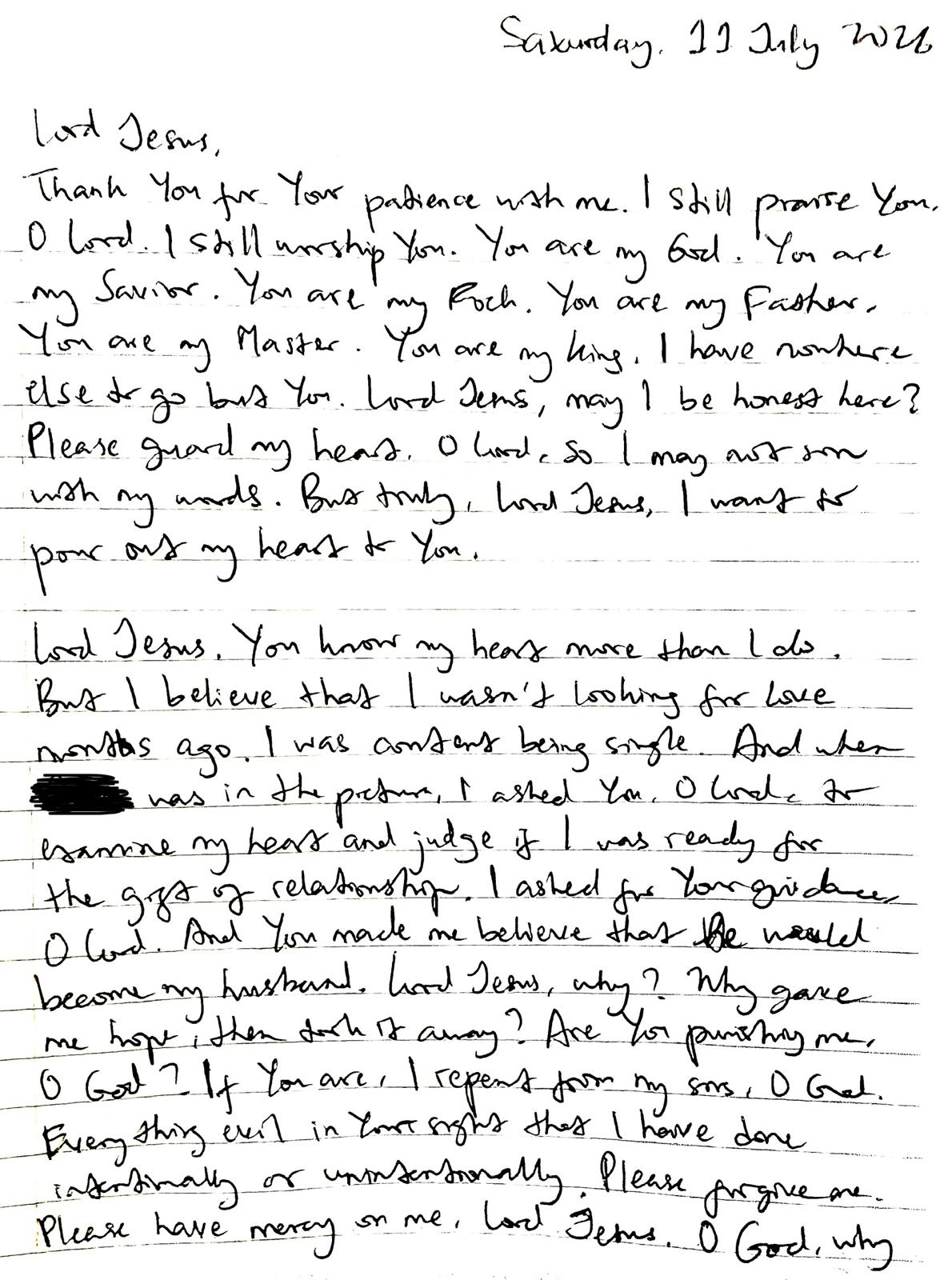
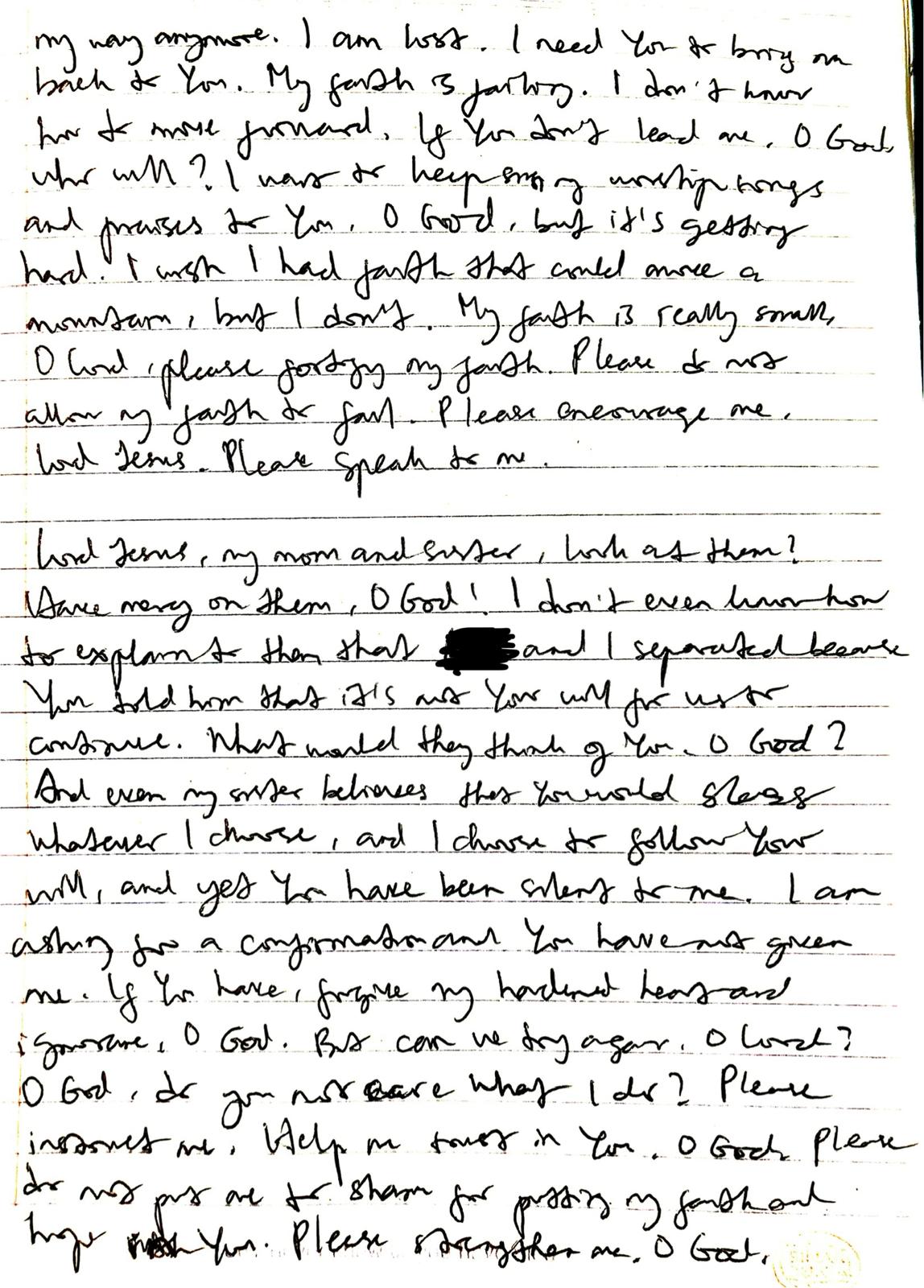
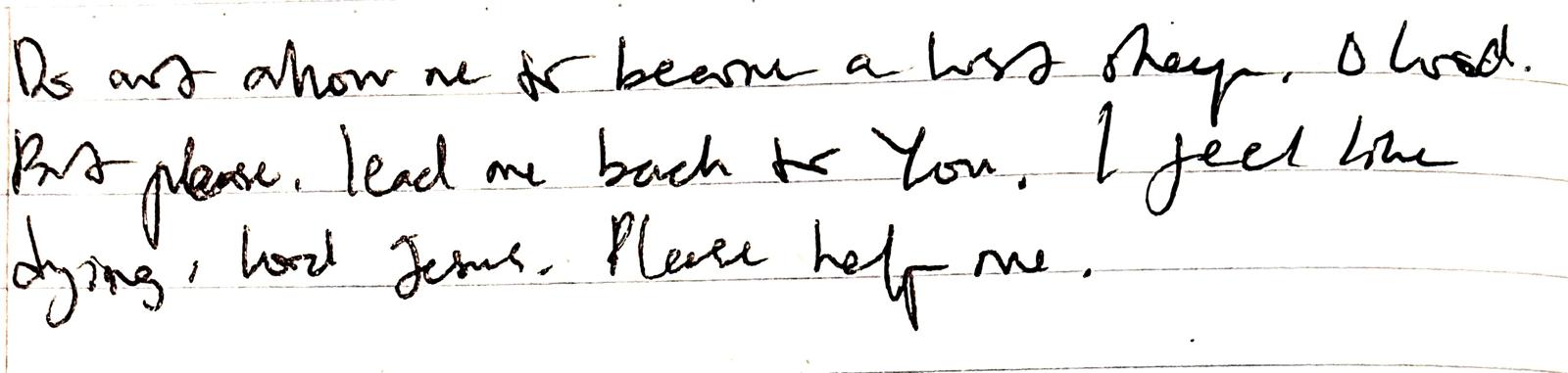
I had been discerning whether to share this deeply personal prayer, but I feel led to do so in the hope that it might encourage others.
I wrote this in July, during the most trying season of this year, and perhaps of my life thus far. What made this trial different from the others was that, instead of feeling as though I had been wronged by other people or that my suffering was the result of difficult life circumstances, I felt as though God Himself had led me to hope for something, only to let me down. In other words, I felt as though I was being played by God.
Throughout my Christian journey, I have had to learn to forgive others and accept circumstances beyond my control. In those situations, my faith in God was the only thing that enabled me to forgive and endure. And so, this trial struck me differently because it made me question the very God I had always turned to for strength. I began to wonder whether He was truly for me and, consequently, whether He was worthy of my trust. Satan bombarded me with lies that I was tempted to believe. Some nights, I wrestled with God, but even when I thought my faith would fail, He did not let it happen.
Lord Jesus,
Thank You for Your patience with me. I still praise You, O Lord. I still worship You. You are my God. You are my Savior. You are my Rock. You are my Father. You are my Master. You are my King. I have nowhere else to go but You. Lord Jesus, may I be honest here? Please guard my heart, O Lord, so I may not sin with my words. But truly, Lord Jesus, I want to pour out my heart to You.
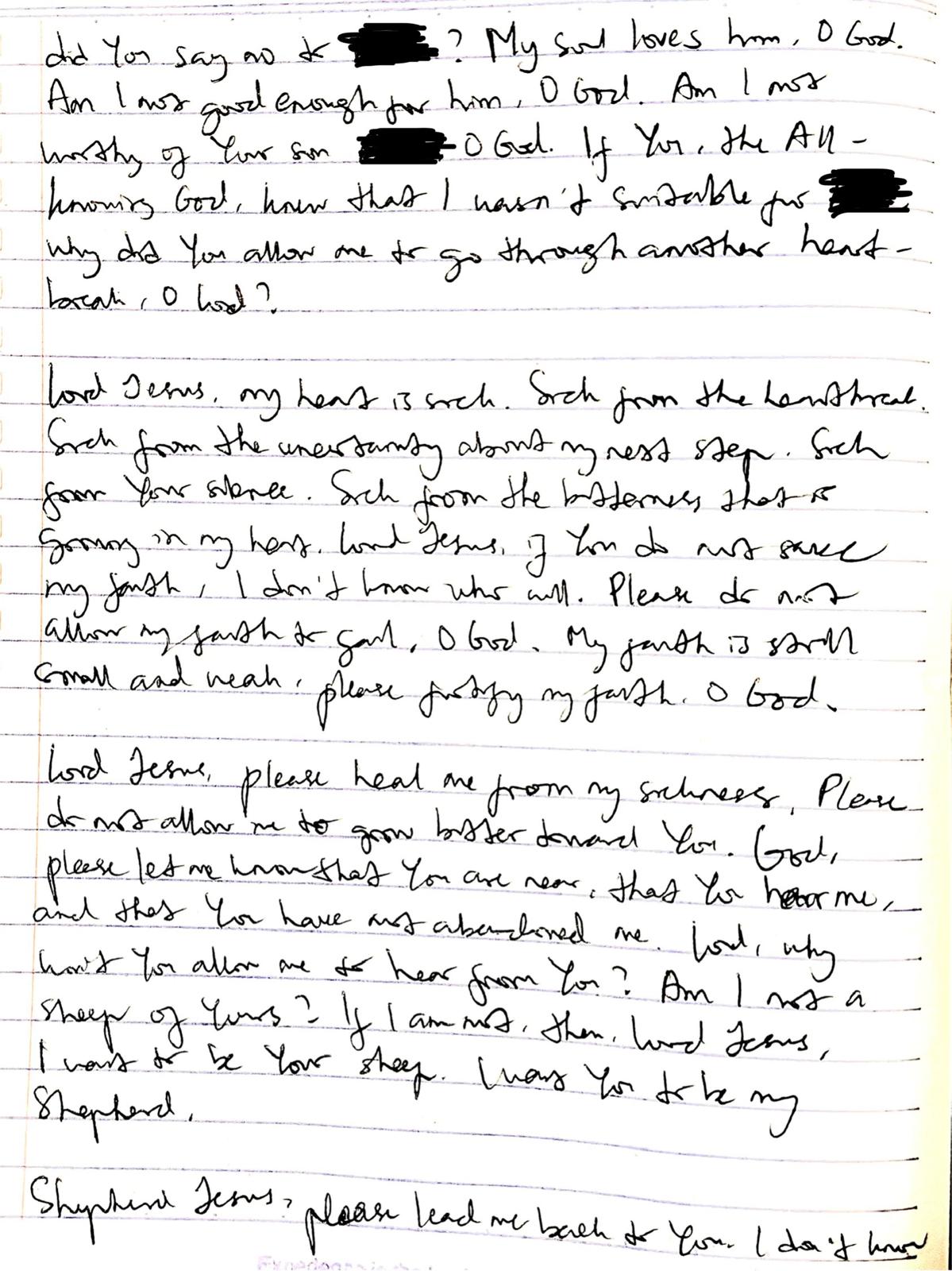
Lord Jesus, You know my heart more than I do. But I believe that I wasn’t looking for love months ago. I was content being single. And when (person) was in the picture, I asked You, O Lord, to examine my heart and judge if I was ready for the gift of relationship. I asked for Your guidance, O Lord. And You made me believe that he would become my husband. Lord Jesus, why? Why gave me hope, then took it away? Are You punishing me, O God? If You are, I repent of my sins, O God. Everything evil in Your sight that I have done, intentionally or unintentionally. Please forgive me. Please have mercy on me, Lord Jesus. O God, why did You say no to (person)? My soul loves him, O God. Am I not good enough for him, O God? Am I not worthy of Your son, (person), O God? If You, the All-Knowing God, knew that I wasn’t suitable for (person), why did You allow me to go through another heartbreak, O God?
Lord Jesus, my heart is sick. Sick from the heartbreak. Sick from the uncertainty about my next step. Sick from Your silence. Sick from the bitterness that is growing in my heart. Lord Jesus, if You do not save my faith, I don’t know who will. Please do not allow my faith to fail, O God. My faith is still small and weak; please fortify my faith, O God.
Lord Jesus, please heal me from my sickness. Please do not allow me to grow bitter toward You. God, please let me know that You are near, that You hear me, and that You have not abandoned me. Lord, why won’t You allow me to hear from You? Am I not a sheep of Yours? If I am not, then, Lord Jesus, I want to be Your sheep. I want You to be my Shepherd.
Shepherd Jesus, please lead me back to You. I don’t know my way anymore. I am lost. I need You to bring me back to You. My faith is failing. I don’t know how to move forward. If you don’t lead me, O God, who will? I want to keep singing worship songs and praises to You. O God, but it’s getting hard. I wish I had faith that could move a mountain, but I don’t. My faith is really small. O Lord, please fortify my faith. Please do not allow my faith to fail. Please encourage me, Lord Jesus. Please speak to me.
Lord Jesus, my mom and sister, look at them! Have mercy on them, O God! I don’t even know how to explain to them that (person) and I separated because You told him that it’s not Your will for us to continue. What would they think of You, O God? And even my sister believes that You would bless whatever I choose, and I choose to follow Your will, and yet You have been silent to me. I am asking for a confirmation and You have not given me. (Note: On top of the heartbreak, I was also discerning the next step of my life and whether I should continue in the work I was doing. My prayer was simple: if God wanted me to continue, I asked Him to change my heart toward my work and strengthen me, trusting that He was able to do so. Otherwise, I asked Him to give me the courage I lacked to step away. By that point, I had been praying for over two months, yet I was still uncertain about what to do. I had no peace about staying, nor did I have peace about leaving. About a month later, however, several circumstances lined up within a short span of time, and I believe God orchestrated them. Through these circumstances, it became clearer to me which direction I should take, and that gave me the courage to move forward into the next chapter of my life.) If you have, forgive my hardened heart and ignorance, O God. But can we try again, O Lord? O God, do You not care what I do? Please instruct me. Help me trust in You, O God. Please do not put me to shame for putting my faith and hope in You. Please strengthen me, O God.
Do not allow me to become a lost sheep, O Lord. But please, lead me back to You. I feel like dying, Lord Jesus. Please help me.
-
The Trial That Made Me Question God's Goodness
If you ask me which trial has shaken my faith the most, I would, without a doubt, point to my most recent one. It led me to question God’s goodness to the point that I began growing bitter toward Him. Calling it a fierce trial would be an understatement.
The experience involved the end of a romantic relationship that I genuinely believed God had arranged. I had fasted and prayed, asking for confirmations, and believed I had received them. One of those confirmations, in particular, felt as though it had been carried out by an angel. The man pursuing me also appeared to be certain. He even told me that the only reason he had moved from friendship (we had known each other for close to a year before that) to pursuing a relationship was that he felt prompted by God. He believed there had been confirmations along the way as well.
After he formally met my mother, but before we moved forward to the next stage of the relationship, I suggested that we fast and pray and stop seeing each other for however long it would take to be sure. He wanted one final, major confirmation from God before committing. I wanted to avoid going through the process of reading books on marriage together, meeting my pastor, and taking other steps toward marriage, only for him to eventually say that God had not given him the confirmation he needed.
After a few days of fasting, he met with me and shared that he felt we were called to different things. He added that he had more peace about not continuing the relationship and believed that peace was God speaking to him.
I was devastated.
I wept bitterly before God for many nights, asking Him why He had allowed me to hope, only for that hope to be taken away. Why would He allow me to believe in one thing, only for the man who had pursued me to believe something different? My questions gradually became even more painful. Was I not good enough for the man who had pursued me? Was God punishing me?
I had reached a point where I was questioning God’s goodness. I felt abandoned, and in that pain, it crossed my mind that if God had abandoned me, should I not abandon Him too? My faith was brought to the verge of collapse. More than once, I had to beg God to fortify my faith because I told Him that if He did not save my faith, who would? And more than once, I asked Him to just take my life.
But God remained faithful. He never failed to send people to reach out to me when I needed prayer the most. On one occasion, He also brought Isaiah 54 to my heart, and the chapter deeply encouraged me.
This experience revealed something in my heart that I had not fully recognized before. I had placed so much confidence in my own faith. I realized how prideful I had been and how much I still treated my relationship with God transactionally.
I always call myself a bondservant of God. And if that is the case, isn’t it up to Him how He wants to use my life? Isn’t He free to give and take away? And should I not remain loyal to Him regardless of the circumstances?
Considering what God has done for me by sending His own Son to die on the cross for my sins, I could serve Him all the days of my life and even die for the gospel, and that would still not be enough to repay His kindness. I could sing praises and worship Him for eternity, and even that would not be sufficient.
The trial lasted for two months. For two whole months, I was bitter toward God. Then, one evening in Dallas, I found myself weeping in a hotel room, lying face down and asking God to forgive me for my bitterness toward Him.
I still don’t think I have all the answers, but so what? Blessed be the name of the Lord! He is worthy of my worship in seasons of blessing and in seasons of breaking. I don’t need to understand everything. If that trial brought me closer to God and helped me grow in Christlikeness, and it did, then that was reason enough!
And I have moved on.
For the longest time, I prayed for God’s will to be done in my life, whatever that might look like. But I feel that God has been challenging me to have joyful and hopeful expectations and to get excited about what is to come.
The day after I repented, I went to the UPPERROOM prayer room in Dallas. During the prayer meeting, the worship leader shared that she felt God wanted her to tell those in the room:
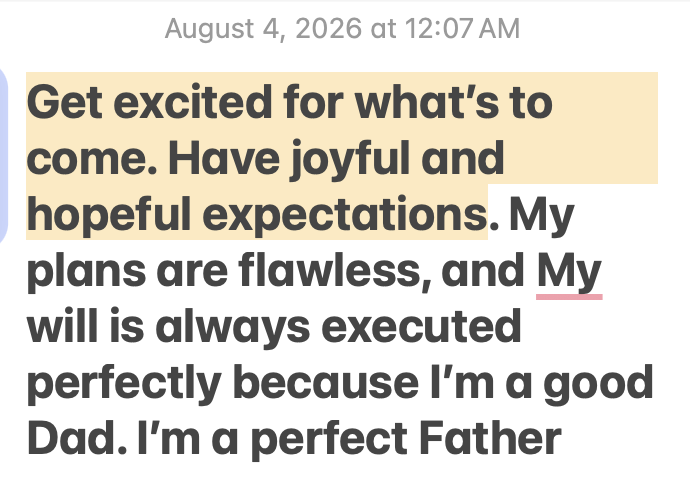
And so, I am choosing to do that. In faith, I eagerly wait for and look forward to what God has in store for me. Blessed be the name of the Lord!
-
What Does Real Faith Look Like?
Today, I listened to two sermons during my walks to and from the gym and while weightlifting. The first was Men Marked by the Presence of God by Paul Washer, and the second was When Disillusioned, Focus on God by Peter Tan-Chi. Interestingly, both touched on the topic of faith. What does real faith look like?
Here’s a direct quote from Washer’s sermon:
It is so hard for us to fathom. I talk to my Pentecostal friends sometimes, and they all say that the greatest demonstration of faith is being able to raise the dead. You raise the dead in a Pentecostal church, you are your upper epsilon. They were saying that one day, and I looked at them and I said, raise the dead? I said, raise the dead? That’s nothing for a Baptist.
Raise the dead? That doesn’t require faith. And they said, well, what requires? I mean, what do you guys consider the greatest exercise of faith? I said, for me to look in the mirror of God’s Word, see the dullness of my heart and the many times that I have offended the King of Glory, and then to actually believe that He loves me like He says He does.
For Paul Washer, it requires more faith to believe that God loves us the way He says He does than to raise the dead.
Peter Tan-Chi similarly referred to Romans 8:32:
He who did not spare his own Son but gave him up for us all, how will he not also with him graciously give us all things?
He reminded his listeners that if God gave us His best, His own Son, will He not also take care of us? He also pointed out that Satan does not want us to believe that God is for us.
In his sermon, Tan-Chi connected faith to trials. He gave the example of a butterfly struggling to break free from its cocoon. This struggle is necessary for its wings to develop, and skipping this process can be fatal because the butterfly needs it to become strong enough to survive. He emphasized that trusting in God’s faithfulness is what enables us to persevere. In his own words, faith is trusting God even when we don’t understand His ways because we trust His character. That way, we can worship God in the midst of trials because we believe He is good!
Interestingly, all of this also connects with Sunday’s sermon at Church of the City, which I attended in person. The preacher, Billy Sprague, shared that praise is costly, defiant, and public. In particular, his message on defiant praise challenged us to think: Do I praise God in the highs and the lows?
Habakkuk 3:17–18 says:
Though the fig tree should not blossom, nor fruit be on the vines, the produce of the olive fail and the fields yield no food, the flock be cut off from the fold and there be no herd in the stalls, yet I will rejoice in the LORD; I will take joy in the God of my salvation.
All of this made me reflect on what faith looks like to me. I used to believe that nothing would ever tear down my faith, but I now realize how prideful I was in my own faith. God eventually brought me through a trial that shook me to the point of questioning His goodness and whether He truly loved me the way the Bible says He does.
I’ll share that story in my next post. For now, I am reminded that faith is not just about believing that God can do miraculous things. In fact, it even makes me wonder: if we measure faith by the miracles God can perform through us, don’t we risk believing that we need to reach a certain level of faith to perform them? And if we do, might we end up idolizing spiritual gifts, such as the gift of healing, or falling into legalism by believing that we need to do more to attain a higher spiritual standing, rather than focusing on God Himself?
If so, I would rather grow in my faith and in my trust that I serve a good, good God.
-
Lord, Make Me Fruitful
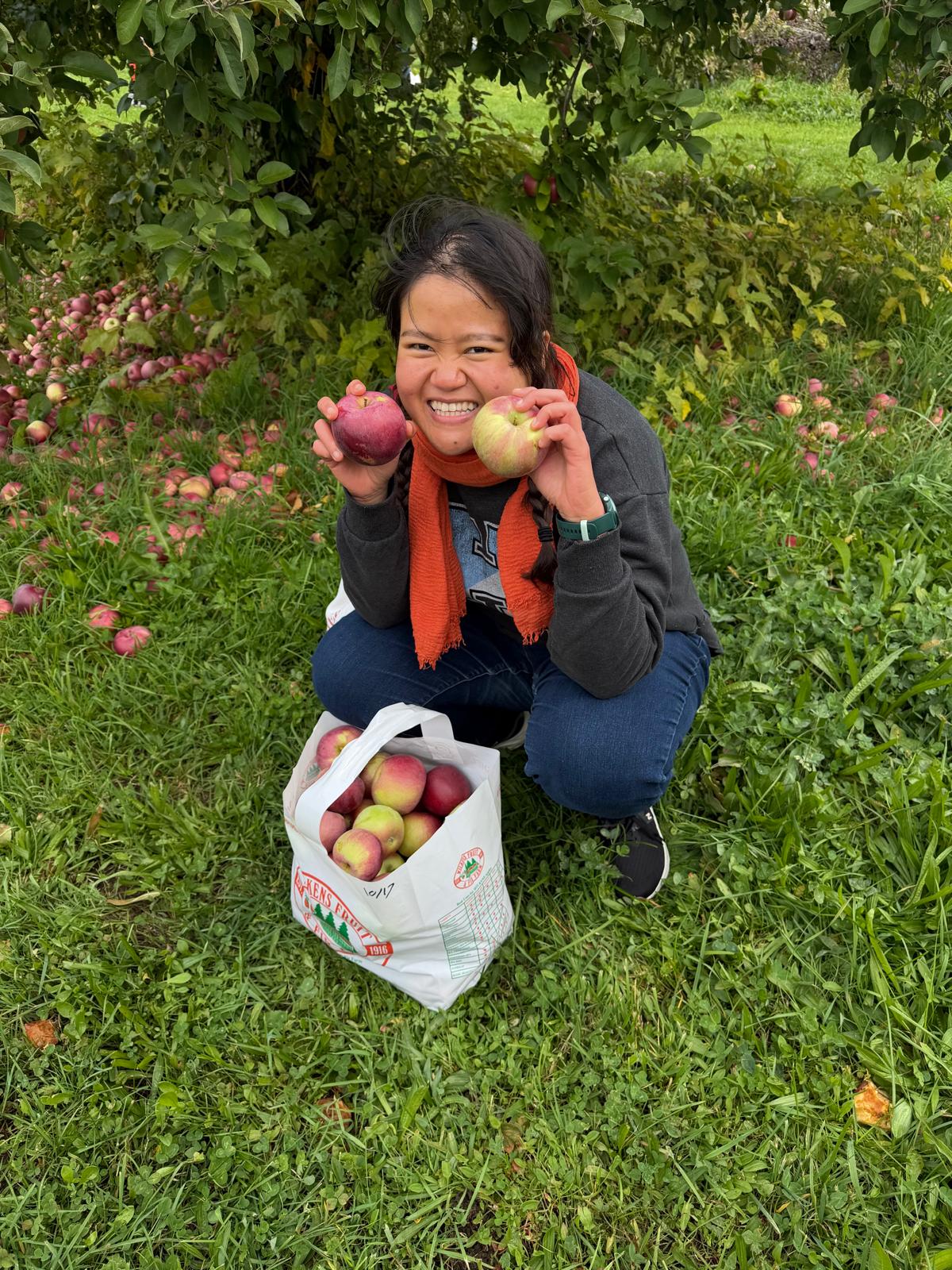
My sister and I went apple picking last Saturday. There was one apple tree on the farm that produced tastier fruit than the others, so we spent most of our time picking apples from that tree. We even told others they should pick apples from it! This got me thinking about what Jesus says in Matthew 7:
Beware of false prophets, who come to you in sheep’s clothing but inwardly are ravenous wolves. You will recognize them by their fruits. Are grapes gathered from thornbushes, or figs from thistles? So, every healthy tree bears good fruit, but the diseased tree bears bad fruit. A healthy tree cannot bear bad fruit, nor can a diseased tree bear good fruit. Every tree that does not bear good fruit is cut down and thrown into the fire. Thus you will recognize them by their fruits.
I truly feel like I need to have these verses bound in my heart. Throughout my life, I have been exposed to various churches and have met ministers who are well known for their healing and prophetic gifts. I have also met Christians who place a strong emphasis on the gift of tongues, as though not speaking in tongues means you are not filled with the Holy Spirit. Don’t get me wrong, though. I myself am very much a continuationist, and in fact, I got saved in a Pentecostal church in 2018!
But as I have grown in my walk with God, I have come to realize that spiritual gifts can become a stumbling block if they lead me to think that I am somehow more favored by God than others. These gifts are meant to serve the church and build one another up (1 Corinthians 14:12), rather than feed my ego. I have also come to realize that giftedness sells. It’s easy to become more drawn to gifted ministers than to the Giver of those gifts.
I do desire spiritual gifts, but only insofar as God sees fit to equip me to serve others and advance His Kingdom. Not more than that. Period.
After all, Jesus also says later in Matthew 7:
Not everyone who says to me, ‘Lord, Lord,’ will enter the kingdom of heaven, but the one who does the will of my Father who is in heaven. On that day many will say to me, ‘Lord, Lord, did we not prophesy in your name, and cast out demons in your name, and do many mighty works in your name?’ And then will I declare to them, ‘I never knew you; depart from me, you workers of lawlessness.’
Now, back to the apple tree. It’s natural to be drawn to what catches our attention, and in church, that might be impressive supernatural works. That’s why discernment matters. What good is a beautifully decorated tree if it produces nasty fruit or bears no fruit at all? If I were a farmer looking to maximize my profits, I would want a tree that produced good fruit, and ideally, plenty of it!
This reminds me of the parable of the barren fig tree in Luke 13:6–9. The owner wanted to cut down a fig tree that had borne no fruit, but the gardener asked for more time to cultivate it. This reminds me that God desires fruitfulness in my life, and I am grateful for His patience as He continues to cultivate and prune me.
And so, it’s not about having the most pleasing-to-the-eye apple tree, but about whether the tree actually produces good fruit. Giftedness may draw attention, but it is the fruit that reveals the tree.
This post is a reminder to myself that giftedness does not equal fruitfulness. I pray that God would help me bear fruit for Him.
-
Lesson #4 From the Caleb Flynn Case
And the last lesson, perhaps the most important one, is about forgiveness. I watched a clip of Ashley’s father making a statement during the trial, in which he said that he and his family had forgiven Caleb. How do you forgive someone you believe murdered your own daughter, sister, and mother? Such forgiveness goes against our natural instincts. Yet what is impossible with man is possible with God. It is only through the work of His Spirit in us that we can faithfully reflect the character of Christ, including His heart of forgiveness.
This reminded me of Jesus as He was hanging on the cross. He prayed for those who crucified Him, as recorded in Luke 23:
And Jesus said, “Father, forgive them, for they know not what they do.”
Similarly, in Acts 7, we read about Stephen, one of the early church’s deacons, who prayed for those who were stoning him:
And as they were stoning Stephen, he called out, “Lord Jesus, receive my spirit.” And falling to his knees he cried out with a loud voice, “Lord, do not hold this sin against them.”
How does God allow those who depend on Him to undergo such suffering, even cruel death and murder? Guess what? I do not fully understand either. But one thing I know is that He can bring good out of even the most terrible circumstances.
This reminded me of a testimony shared by Pastor Peter Tan-Chi. One of his daughters was sexually assaulted as a teenager by several robbers who broke into their house. The pastor shared how he spent many nights crying and asking God why He would allow such a thing to happen. However, he later shared that when his daughter spoke about forgiving the men who assaulted her during an interview on a Christian radio station, her testimony led to the highest number of calls the station had ever received from people wanting to give their lives to Jesus. What the enemy meant for evil, God turned for good.
And here’s the clip of Ashley’s family’s statement of forgiveness. It has certainly impacted at least one person: me. My faith was deeply encouraged by hearing their words and seeing how they embodied the love of Christ. In his statement, Ashley’s father said:
Jesus tells us that if we want to be forgiven of our sins, we must forgive others their sins. And I want you to know that Jill, myself, and our whole entire family that’s here and everywhere, we forgive you for taking Ashley’s life and also for what you have done to all of us.
I trust that God can use their testimony to touch many more hearts and draw people to Himself. May He use their testimony for His glory.
-
Lesson #3 From the Caleb Flynn Case
I also read a news article about Caleb’s parents asking the judge for mercy for their son. His mother described him as someone his peers looked up to, who demonstrated responsibility, hard work, and diligence. To my knowledge, Caleb continues to maintain his not-guilty plea. Only God knows what truly happened. However, I found myself reflecting on a difficult possibility: if he had indeed committed such a crime and continued to deny it, how desperately he would need to humble himself and acknowledge his wrongdoing.
In that case, seeking mercy for him in the form of a reduced sentence from an earthly judge would be insignificant compared to seeking God’s mercy for their son. Ultimately, the mercy he would need most, if he were guilty, would be for his heart to be brought to repentance, rather than simply to be spared the consequences of his actions.
An earthly judge can indeed determine a person’s sentence in this life, but our ultimate need is to be reconciled to God. Jesus reminds us not to fear those who can kill the body but cannot kill the soul, but rather to fear Him who can destroy both soul and body in hell (Matthew 10:28). A life sentence is serious, but eternity is far more serious still.
On the other hand, if Caleb is innocent, as he maintains, I still believe it is wise to seek God’s mercy above all. I hold to the conviction that our battles and struggles are to be fought in the secret place before God. He is sovereign, and He can bring the truth to light.
I am encouraged by the support Caleb’s parents have shown him. Honestly, rather than focusing on where I stand on this issue, I would rather reflect on what I can learn from this case. One conviction I am taking away is that I still have much to learn about where to draw the line between loving our family and honoring God.
This also reminded me of 1 Samuel 2–3, where we read about Eli’s wicked sons, who served as priests. What struck me was that Eli rebuked his sons (1 Samuel 2:23) but did not restrain them from their wickedness. In verse 29, God rebuked Eli for honoring his sons above Him.
Why then do you scorn my sacrifices and my offerings that I commanded for my dwelling, and honor your sons above me by fattening yourselves on the choicest parts of every offering of my people Israel?
This case has led me to reflect more on what it means to build a godly family. It reminds me of the importance of spiritual leadership within a family, especially the responsibility of a father to lead his household in honoring God. Eli’s failure to deal decisively with his sons’ wickedness brought judgment upon his household and had consequences for the nation of Israel, including the defeat of its army and the capture of the Ark of God.
If God ever grants me the opportunity to become a parent, I pray that He will give me a heart that honors Him above even my own children. May I never allow my affection for my family to cause me to disobey God.
Truly, we need God’s wisdom in navigating these situations. May He grant us the courage to honor Him above all else.
-
Lesson #2 From the Caleb Flynn Case
Another thing that the Caleb Flynn case has caused me to think about is the weight of appointing leaders in the church. We certainly ought to seek God’s will in every decision, big or small, and even more so in matters pertaining to the church. I believe seeking God’s direction in the process of discerning and electing leaders is essential because He alone ultimately knows the hearts of men. Even the first disciples sought God’s direction in a matter such as this, as seen in Acts 1:
And they prayed and said, “You, Lord, who know the hearts of all, show which one of these two you have chosen to take the place in this ministry and apostleship from which Judas turned aside to go to his own place.” And they cast lots for them, and the lot fell on Matthias, and he was numbered with the eleven apostles.
Earlier this year, my campus Bible study organization was preparing to elect new leaders through nominations and voting by the current leaders, and I happened to be one of them. I felt convicted in my heart to fast, and two friends from the Bible study were also led to join me. We all fasted and prayed for ten days leading up to the election. We asked not only for discernment but also for protection from the schemes of the enemy, as the campus ministry was growing. We were mindful that wolves in sheep’s clothing could be used by the enemy to tear down the campus organization from within.
Now that I have moved on from the campus organization in Baltimore, I am grateful to see God continuing to send laborers who are on fire for Him to serve as new leaders in the campus ministry at Johns Hopkins. This gives me a deep sense of peace as I move forward into the next chapter of my life in New York.
The Caleb Flynn case has reminded me not to take the responsibility of appointing leaders in the church lightly. At the same time, I am reminded of Psalm 127:1, which says, “Unless the LORD builds the house, those who build it labor in vain.” I pray that we would all keep the bigger picture in mind: God must be the one building the house. We can serve in many different ways and take part in all kinds of ministry, but I think we, as the church, ought to ask ourselves: Is God the one building the house? Otherwise, we risk laboring in vain. What matters most, then, is that we keep Jesus at the center of everything we do.
-
Lesson #1 From the Caleb Flynn Case
Today, I learned about the Caleb Flynn case. From what I understand, he was a worship pastor, as was the woman he was allegedly having an affair with while his wife was still alive.
I don’t usually follow crime cases or news, but this one caught my attention. All I can say is that I pray God would lead him to godly sorrow and sincere repentance.
While reading comments from people online, I noticed that some questioned whether Caleb had ever been a Christian to begin with. And that made me reflect on what makes someone a true follower of Christ.
Coincidentally, I have been listening to and relistening to this sermon by Paul Washer titled A Sermon That Has Angered Many: Examine Yourself. His sermon is based on 1 John 1:
This is the message we have heard from him and proclaim to you, that God is light, and in him is no darkness at all. If we say we have fellowship with him while we walk in darkness, we lie and do not practice the truth. But if we walk in the light, as he is in the light, we have fellowship with one another, and the blood of Jesus his Son cleanses us from all sin. If we say we have no sin, we deceive ourselves, and the truth is not in us. If we confess our sins, he is faithful and just to forgive us our sins and to cleanse us from all unrighteousness. If we say we have not sinned, we make him a liar, and his word is not in us.
I agree with Washer’s statement:
The Bible teaches that even the most mature, the most godly Christian is still susceptible to sin. What this is teaching us is this. One of the greatest evidence is that a person has truly been born again, that a person is truly a child of God, is that they will be sensitive to the sin in their life and they will be led to repentance and confession of that sin.
Ephesians 1:13–14 tells us that the Holy Spirit is the guarantee of our inheritance. Hence, I agree with Washer that ongoing sensitivity to sin that leads to confession and repentance is evidence of the Spirit’s work in us and, therefore, of our salvation. According to 1 John, Christians are still susceptible to sin, for if we say we have not sinned, we make Him a liar. Yet, as God works in us, His Spirit makes us increasingly aware of our sin and our need for God’s mercy through repentance. However, I would like to emphasize that I am saved not because of my ability to recognize my sins, but solely because of God’s grace through faith in Christ.
To close, I trust that it is God’s grace that this whole situation, including the exposure of Caleb’s alleged affair, has come to light. God could have taken his life away, leaving him no more opportunity to repent, but he is still alive, and I pray that he will turn to God while he still has the opportunity. May God soften his heart and lead him to true repentance. May God also use his story to encourage his fellow prisoners to come to Christ too.
-
Many Times More
Reading Luke 18:29 hit my heart today:
And he said to them, “Truly, I say to you, there is no one who has left house or wife or brothers or parents or children, for the sake of the kingdom of God, who will not receive many times more in this time, and in the age to come eternal life.”
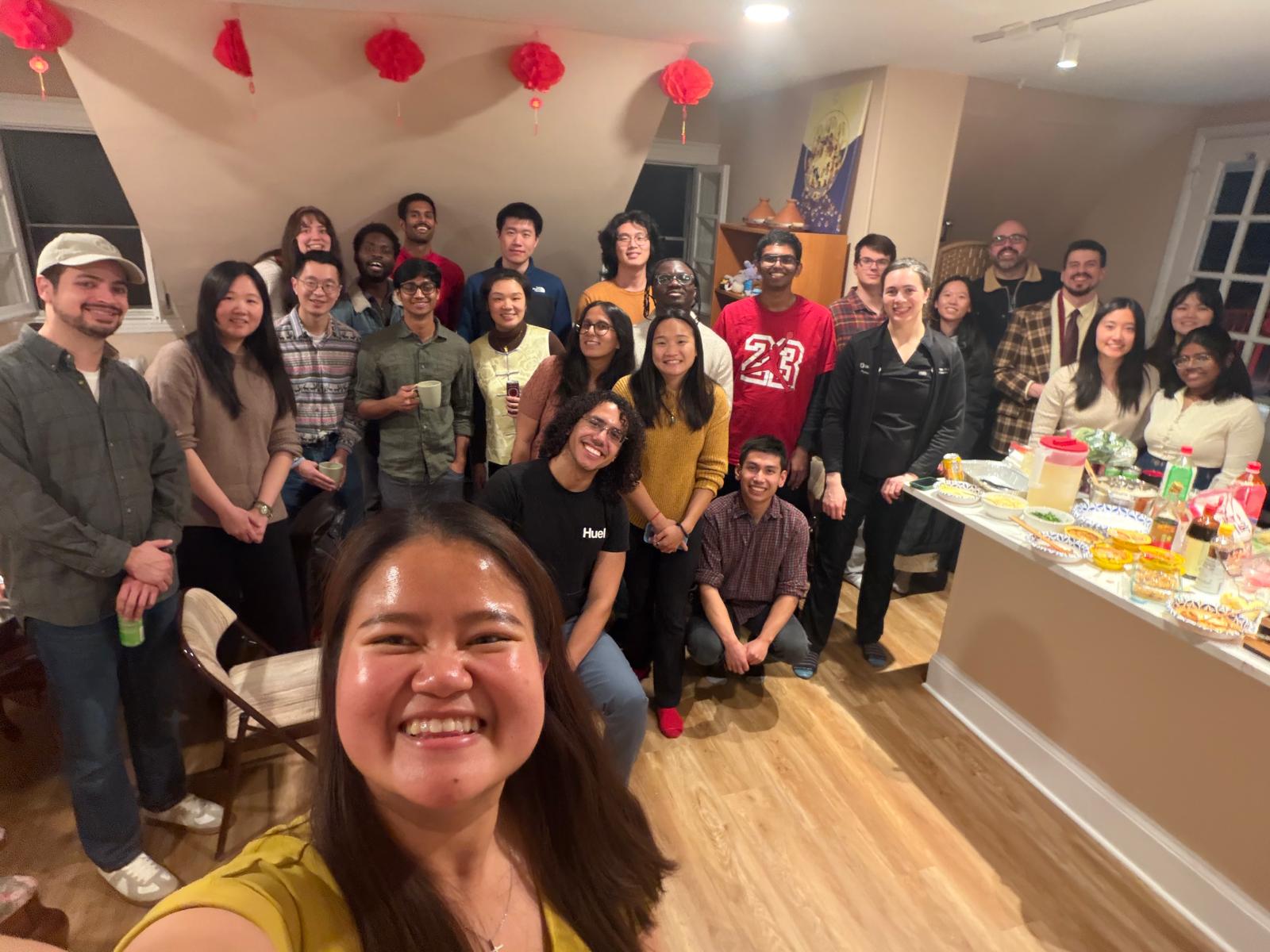
I have said yes, and will continue to say yes, to wherever God sends me. For the past ten years, since I first left my hometown of Bangka Belitung, Indonesia, God has led me to live in various places: Australia for two years, China for a year and a half, Bali for six months, Malang for two months, Baltimore for four years, and now NYC, where I’ve been for about two months.
In Australia, I gave my life to Jesus. Then I went to China for my undergraduate studies, where I formed close friendships with two brothers from Zimbabwe. We went to a local church together on Sundays and met throughout the week for Bible study, fellowship, and worship. Eventually, we became part of the planting team of an English-service church. The last time I reached out to one of these brothers, I learned that he had become a preacher in China and that God had grown the church to three branches. All glory to Him alone!
In Malang, I stayed with a Spirit-filled Christian auntie for two months, and she greatly encouraged me in my walk with God. In Baltimore, I became involved in the Graduate Christian Fellowship chapter of InterVarsity on my campus. God blessed me with fellow laborers in Christ who challenged me to grow in my faith, as iron sharpens iron, and with many brothers and sisters who made Baltimore feel like home.
Here’s my Baltimore community at a Lunar New Year celebration I hosted!
And now, in NYC, God has already brought Christians into my life who make me pray that He would let me stay here for some time.
I can testify that I have received many times more, even in this life. In each place, God has given me far more than I could have imagined. The family I have found in Christ is worth more than silver and gold.
Jesus Himself said in Mark 3:34–35:
“Here are my mother and my brothers! For whoever does the will of God, he is my brother and sister and mother.”
Yet as precious as these communities are, the greatest gift is knowing Christ Himself. I would rather be at His feet than anywhere else.
-
Can I Truly Say I Love God
I feel like a liar. It is so easy for me to say, “I love You, God.” In fact, I have been listening to a song titled I Love You Lord on repeat for the past few months. And yet, the Bible says that if I love God, I will keep His commandments (John 14:15). When I look at my own life, I have to confront myself with these questions: Am I sincerely seeking to obey His commands? What is my relationship with His Word? Am I seeking His wisdom and putting it into practice?
When I love someone, I love spending time with them. If I am to love God as He deserves to be loved, with all my heart, mind, soul, and strength, allowing no other idols to rival Him, should I not also long to spend time in His presence above all else? Do I spend more time communing with God each day, or scrolling on my phone? I was meditating on Psalm 63, and it grieved my heart to realize how little I seem to thirst for God as David, a man after God’s own heart, did. Do I seek Him earnestly, with my whole being, longing for Him? Can it be said that I love Him so deeply that His steadfast love is better than life itself? When I lie in bed, is He the last thought on my mind? Am I clinging to Him as I ought to?
Oh, wicked heart! It grieves me that Scripture has revealed how little I love God. Now that I have been pondering this, how can I ever again say, “I love You, God,” lightly, without feeling like a liar?
May God continue to teach me what it means to love Him and draw my heart closer to His. May “I love You, God” be more than words on my lips, but be reflected in how I pursue and obey Him.
-
What if God Gives Me Abundance
I have been meditating on the parable of the rich fool in Luke 12:
“The land of a rich man produced plentifully, and he thought to himself, ‘What shall I do, for I have nowhere to store my crops?’ And he said, ‘I will do this: I will tear down my barns and build larger ones, and there I will store all my grain and my goods. And I will say to my soul, “Soul, you have ample goods laid up for many years; relax, eat, drink, be merry.”’ But God said to him, ‘Fool! This night your soul is required of you, and the things you have prepared, whose will they be?’ So is the one who lays up treasure for himself and is not rich toward God.”
Just before telling this parable, Jesus said:
“Take care, and be on your guard against all covetousness, for one’s life does not consist in the abundance of his possessions.”
One of the most life-changing talks I attended was at the Urbana conference in Phoenix, Arizona, in 2025. The speakers were a couple who run a construction company that has been richly blessed. One of the most striking decisions they made was to pay themselves only a salary comparable to that of a college teacher, choosing to live humbly even though they could certainly afford a lavish lifestyle.
Their decision was not always understood by others, including those closest to them. The husband shared that he had even been labeled neglectful toward his family. In a way, I can understand why people might think that. If you know someone who runs a highly successful business, shouldn’t that success be reflected in their lifestyle? Shouldn’t they upgrade their home to a mansion or perhaps even buy a private jet?
Yet their purpose in running the business was to support missionaries. They had dedicated a substantial portion of their profits to mission work. If I remember correctly, the company had contributed hundreds of millions of dollars toward advancing God’s kingdom.
Hearing their story made me reflect on how I might want to approach money if God were to bless me with abundant wealth in the future. I hope to follow in their footsteps by living on a modest, middle-income salary, regardless of how much I might earn, and giving the abundance to advance God’s kingdom. Perhaps, one day, that might mean helping to build Christian schools and orphanages.
At the same time, I know that it is one thing to think about these things and another to live them out when faced with the temptations that wealth might bring. I pray that God will continue to guard my heart, keep my eyes fixed on Jesus, and remind me that my life does not consist in the abundance of what I possess. May He keep me from becoming too attached to this life.
Note: I’ve been trying to remember the couple’s names, but I just can’t seem to recall them. I couldn’t find their seminar listed on the Urbana website either. Hopefully, I’ll come across their story again someday!
-
The Humility to Receive
At one point in my life, my idea of an ideal life was to live all by myself in the middle of the jungle. I worked through this with a therapist over multiple sessions, but what really stuck with me was her reminder that even Jesus had 12 disciples! We are never meant to be lone wolves. Funny enough, this wasn’t Christian counseling, and I don’t know whether my therapist had any religious affiliation. I did mention to her at the beginning that my Christian faith plays a big role in my life, though. And praise God! He is sovereign, and He used my therapist to speak to me.
However, even when I was tempted to withdraw and live in seclusion, I did not appear antisocial at all. If anything, I have always been known as a connector, someone who introduces people to each other and brings people together through involvement in various communities and social groups. Even back then, I was known as the person who seemed to know everyone.
Yet despite knowing so many people, I wasn’t satisfied with my friendships. I felt that most people only knew me superficially. To top it all, I also approached friendships more transactionally. Looking back, I realize that I often thought about what I could gain from friendships and communities rather than what I could contribute to them.
But God has changed my heart. I now see friendships as opportunities to extend God’s love to others. In my individual interactions, I find myself asking questions like, What can I bring into this friendship? How can I better encourage this friend? And when it comes to being part of a community, instead of asking myself what I can gain from it, I now ask myself, What can I give to this community?
So, what changed in the way I approached relationships? Pride.
Don’t get me wrong. I am not saying that receiving from our friendships and communities is unimportant. In fact, that is another area where I have had to confront my pride. I have realized that it takes humility to be willing to receive. It takes humility to ask for help. It takes humility to be vulnerable and ask others to pray for you.
Pride, on the other hand, keeps us from receiving. It does not want us to give other people the opportunity to serve us. Instead, it encourages us to feel good about ourselves for always being the one who gives, for being the person others can rely on, and for not needing anything in return.
This reminds me of something Timothy Keller shared in his book The Meaning of Marriage about an interaction with his wife, Kathy. Although he was writing in the context of marriage, I think the principle applies to ordinary friendships, too.
And what is that gospel? It is that you are so lost and flawed, so sinful, that Jesus had to die for you, but you are also so loved and valued that Jesus was glad to die for you. Now you are fully accepted and delighted in by the Father, not because you deserve it but only by free grace. My reluctance to let Kathy serve me was, in the end, a refusal to live my life on the basis of grace. I wanted to earn everything. I wanted no one to give me any favors. I wanted to give undeserved gifts to others—so I could have satisfaction of thinking of myself as a magnanimous person—but I did not want to receive someone else’s service myself. My heart still operated like this even though my head had accepted the basic gospel thesis that through faith in Christ we live by God’s grace alone.
That gospel message should both humble and lift the believer up at the same time. It teaches us that we are indeed self-centered sinners. It perforates our illusions about our goodness and superiority. But the gospel also fills us with more love and affirmation than we could ever imagine. It means we don’t need to earn our self-worth through incessant service and work. It means also that we don’t mind so much when we are deprived of some comfort, compliment, or reward. We don’t have to keep records and accounts anymore. We can freely give and freely receive.
What stood out to me in Keller’s reflection is the connection between receiving from others and living by grace. If learning to receive means learning to live on the basis of grace, then I pray that God will continue to humble me. I feel that God has been using this ongoing process of confronting my pride to teach me to seek the good of others (1 Corinthians 10:24) and count others more significant than myself (Philippians 2:3), both in my individual interactions and in the communities I am part of. At the same time, He has been teaching me to receive from others with humility.
God has brought me from wanting to live alone in the jungle to learning to give and receive more freely. Before moving to NYC, I was nominated and elected to serve as the Social Committee Chair for my campus graduate InterVarsity chapter and as the Social Director of my research lab. I am grateful for the rich communities God has planted me in and for how He has helped me appreciate these relationships more than I used to. Rather than leaving me feeling burnt out, these friendships and communities have become sources of refreshment for my soul.
I have also come to realize that the transformation God works in us does not affect only us. As He changes how we relate to others, that change can also shape the dynamics of the communities we are part of for the better.
Ultimately, this transformation is not something I can take credit for. It is truly the work of His Spirit in me.
-
Healthier Adele
Earlier this week, my church small group talked about the things we appreciate more now than we used to. I shared two things with my group: health and community. If you’ve been reading my previous posts, you might have noticed that I’ve been reflecting quite a bit on the transformation of my desires. And so, I thought I’d share how I’ve experienced transformation in these two areas of my life as well.
I’ve lost around 20 pounds over the past year and a half. Most of the weight loss came from starting weightlifting and adopting a high-protein, lower-calorie meal prep routine. I typically aim to lift weights two to four times a week, even though I must admit that I haven’t always been consistent. There have been weeks when I didn’t lift at all and ate rather mindlessly. As a result, my progress has been a bit slower than I would have liked. Still, I’m grateful that feeling guilty whenever I fell off track didn’t stop me from trying again! And here I am, a year and a half later, still lifting weights and meal prepping. So, Adele 1, guilt 0.
For the past two weeks or so, I’ve also made it a goal to walk at least 10,000 steps every day. Out of 17 days, I missed my goal on three of them. That’s okay, though. I’m learning that what’s more important is to just keep going!
I’ll share more about the community part in my next post.
-
My Growing Gospel Music Playlist
One change I have noticed in my desires is that I am no longer as interested in secular music as I used to be.
Mind you, I listen to a lot of music. I love music. I consistently listen to more than 2,000 minutes of music every week on Spotify alone. And I have found that you can never listen to too many gospel songs!
I have been adding songs to this playlist for about a year and a half, and I am still discovering new ones. It has now grown to over 50 hours of music!
Anyway, I thought I would share my playlist here. The songs are in order from oldest to newest, based on when I added them, so if you are ever curious about what I have been listening to lately, you can scroll to the bottom.
Let us sing praises and worship our God!
-
More Like Jesus
I prayed that God would not give me what I wanted.
Here’s why. I have realized that many of my desires were not rooted in a desire to glorify God. I wanted a job that would elevate my social status, something my family could proudly brag about. I wanted an easy life filled with material abundance. I wanted a future partner who was capable enough not to need much from me, someone who would support me in doing whatever I wanted to do in life.
However, I have been convicted that getting everything my heart wants would not necessarily be a sign of God’s blessing.
Romans 1:28 says:
“And since they did not see fit to acknowledge God, God gave them up to a debased mind to do what ought not to be done.”
Based on this verse, I have come to realize that getting exactly what we, as human beings with a sinful nature, want can sometimes be a form of judgment. Hence, my prayer is that God would not give me over to the desires of my flesh, but instead transform my heart so that I would desire what He desires.
It has been a process, and I can see how my heart has been undergoing transformation. Many things I used to desire, I no longer desire. In fact, the changes have been so striking that I have been humbled to acknowledge that I indeed do not even know what I truly need or what is best for me. Only God does.
I also remember the suffering and trials I have gone through, as well as those I am still going through, that have been part of this transformation. The process has been fierce. The desires of my flesh are at war with the desires of the Spirit, and I can feel that struggle within me.
My deepest desire is to be conformed to the image of Christ, even though my flesh does not always desire it. I pray that God would continue to prune, break, melt, and refine me to become more like Jesus. Even when my flesh groans, I pray that He would continue His work in me and give me the faith to endure.
I must admit that I did not always have this understanding. There have been times in my life when I was going through such intense suffering that I asked God why He allowed me to experience it. However, looking back, I can see how He has used my suffering to help me grow in Christlikeness. There may be other reasons for the suffering I have experienced, and I may never know them. However, do I really need to know them? What matters is that I am being shaped into the image of Christ.
Romans 8:28-29 says:
“And we know that for those who love God all things work together for good, for those who are called according to his purpose. For those whom he foreknew he also predestined to be conformed to the image of his Son, in order that he might be the firstborn among many brothers.”
Truly, what could be a greater good than being conformed to the image of His Son?
I have come to trust that God can use anything and everything in my life to conform me to the image of Christ, including circumstances I do not even understand. I now believe that my transformation into the likeness of Jesus matters more than any earthly achievement or ambition. And that helps me not to overcomplicate things.
I echo what Paul Washer said in one of his sermons: “God doesn’t care about your ministry as much as He cares about your conformity to the image of Christ.” If you have read my post, The Goal Is to Love God, I think the two reflections connect with each other.
I don’t need to overthink every detail of God’s will for my life or figure out every step of the way ahead of time. I trust that He is directing my steps, whether I realize it or not. This does not mean I should stop seeking wisdom or discerning what is pleasing to Him! Rather, what I ought to focus on is simply being faithful with what He has placed before me and seeking first His Kingdom and His righteousness above all else.
I also don’t need to overthink why every particular thing happens in my life. I will never understand everything, but I trust God’s wisdom and sovereignty. I trust Him to work through my circumstances according to His purposes and to continue shaping me into the image of Christ. And I trust that as I become more like Christ, I will also grow in my love for God with all my heart, soul, mind, and strength. After all, Jesus Himself kept His Father’s commandments and abided in His love (John 15:10).
Therefore, perhaps the most important questions to ask myself at the end of each day are these: Am I being conformed to the image of Christ? Am I becoming more like Jesus today?
-
A Loss Worth Having
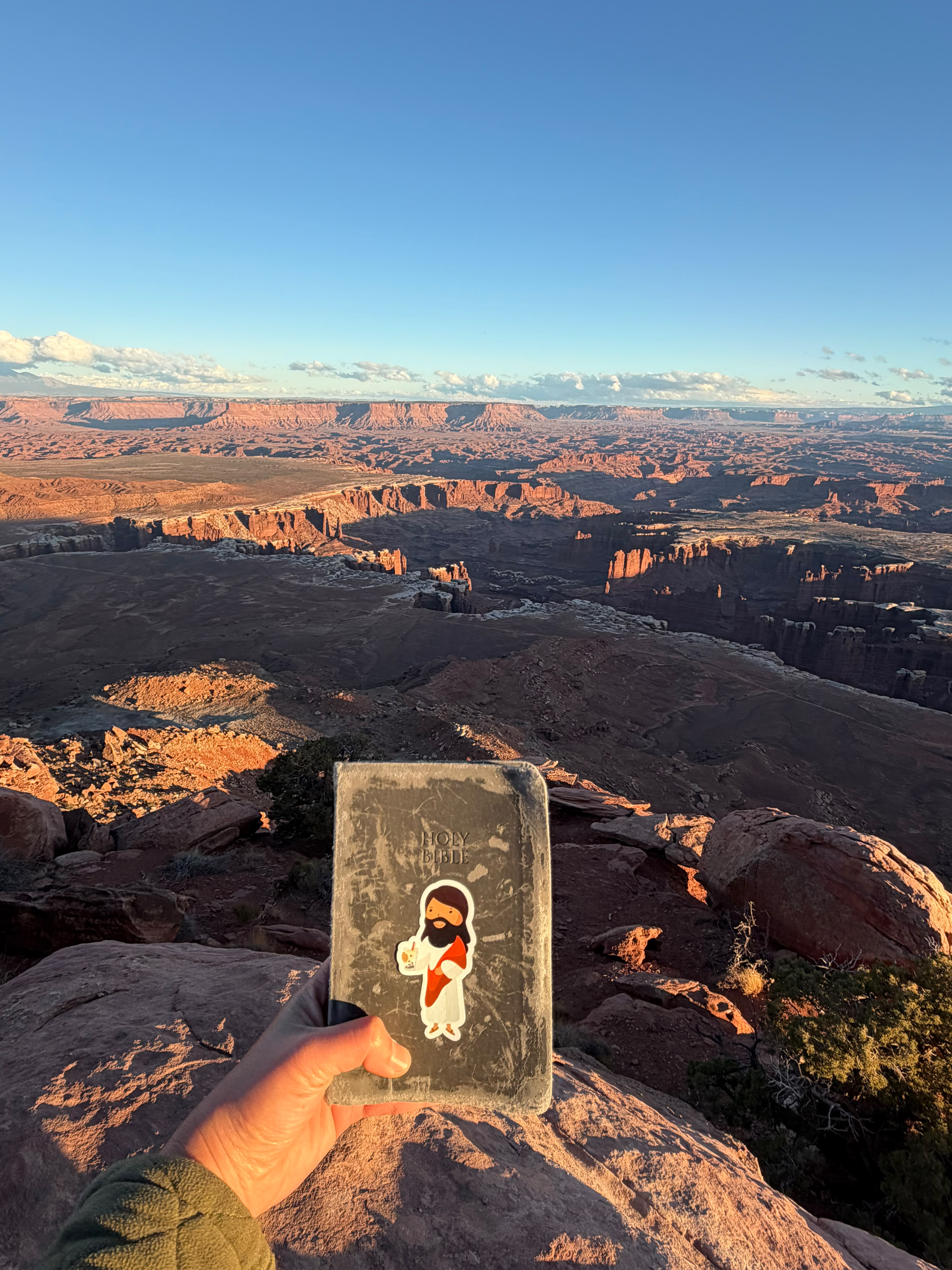
I lost one of my Bibles.
My other Bibles mostly stay at home, but this compact Bible has traveled with me everywhere: on adventures around the globe, to work, on walks, and everywhere in between. It fits perfectly in my fanny pack. I’ve had it for a couple of years, and it has accumulated more notes and highlights than any of my other Bibles. It even has a fun sticker of Jesus holding boba on the cover.
I think I left it at church last Sunday. But strangely enough, I am not particularly bothered by it. I could rush back and try to find it, but I don’t feel the need to. If I find it again this coming Sunday, sure. If I don’t, I don’t mind.
I think the Bible is the only thing I own that I would happily lose.
I don’t mean losing it in the sense of it being accidentally thrown into the ocean or something. I would be sad if that happened. However, I would be delighted if someone else found it, flipped through it, read it, or even took it home and made it their own.
If its pages lead someone to Jesus, I would, without a doubt, be grateful that I lost it.
-
The Weight of Authority
An important lesson I learned today is that having authority is supposed to cost me, not benefit me.
Luke 12:48 says:
“Everyone to whom much was given, of him much will be required, and from him to whom they entrusted much, they will demand the more.”
The lesson came from a sermon that I listened to on my walk today titled The Child’s Responsibility to the Parents by Paul Washer. Here is a direct quotation of what he shared:
You know, anytime I teach on authority or I teach on something like submission, whether it be a wife honoring her husband or children honoring their parents, it’s a frightening thing to teach on it. Why? Well, this is the reason. I have met in my life so many self-centered, power-hungry, legalistic husbands and fathers who love to use these types of teachings in order just to literally enslave their wives and children and their spirit, their heart, everything about them is totally contrary, totally contrary to the lordship of Jesus Christ, his compassion, his love, his mercy.
When we talk about, you know, a certain person should submit to another person and that some persons have been given authority, those who have been given authority ought to have great fear because to whom much is given, much is required. If you have been given a wife, know that she is a daughter of God and God will deal with you one day. If you have been harsh with her, if you have used her for your own promotion, God will deal with you.
And know this, if you’re a father, your children are to obey you. But if you have been harsh, manipulative, coercive, managing everything in your home just by sheer power, God will deal with you one day and you need to be afraid. Repent now.
Reconcile yourself with your enemy before you go to court because you will not get out of there until you’ve paid the very last cent. Those who have authority of any kind, whether it’s in the family, in the church, they ought to exercise that authority like a servant. That authority ought to cost them and not benefit them.
How is this relevant to my life? Throughout my life, I have been entrusted to lead in various capacities. This serves as a reminder for me to exercise any authority given to me with great fear, like a servant. I myself am under the authority of Jesus Christ, and I submit myself to God. I will have to one day give an account of everything and everyone He has entrusted to me.
One of the things I am anticipating in my life that also induces much apprehension is the thought of having kids in the future. I do not take this lightly in the slightest. Like, hey, my future kids are daughters and sons of God too! Yes, I will have authority over them as a mother, but I have learned that this authority is supposed to be a costly responsibility. They are children of God just as much as I am, and one day, I will have to give an account before God, before His throne, for how I use the authority He gives me over them. That is honestly a weighty thought.
I have a lot to learn here. May God prepare me for the responsibility of motherhood and continually remind me that the authority He gives me is meant to cost me, not benefit me. May He make me the kind of mother who is willing to sacrifice for her children. And most importantly, may I, by the power of the Holy Spirit, faithfully point my future children to Jesus.
-
Numbering My Days
Sunday’s sermon was about having an eternal perspective, and the preacher mentioned the practice of writing an eulogy. I thought it could be a meaningful exercise to help me live more missionally, with eternity in mind. I want to number my days, weigh my decisions carefully, and fix my eyes on Jesus, as Pastor Sam Gibson encouraged us to do.
Psalm 90:12 says:
“So teach us to number our days that we may get a heart of wisdom.”
Then I remembered that I had actually written something back in January. It’s not a comprehensive eulogy, but it contains some thoughts about how I would want my physical remains to be handled and, more importantly, how I would want people to honor the legacy I leave behind:
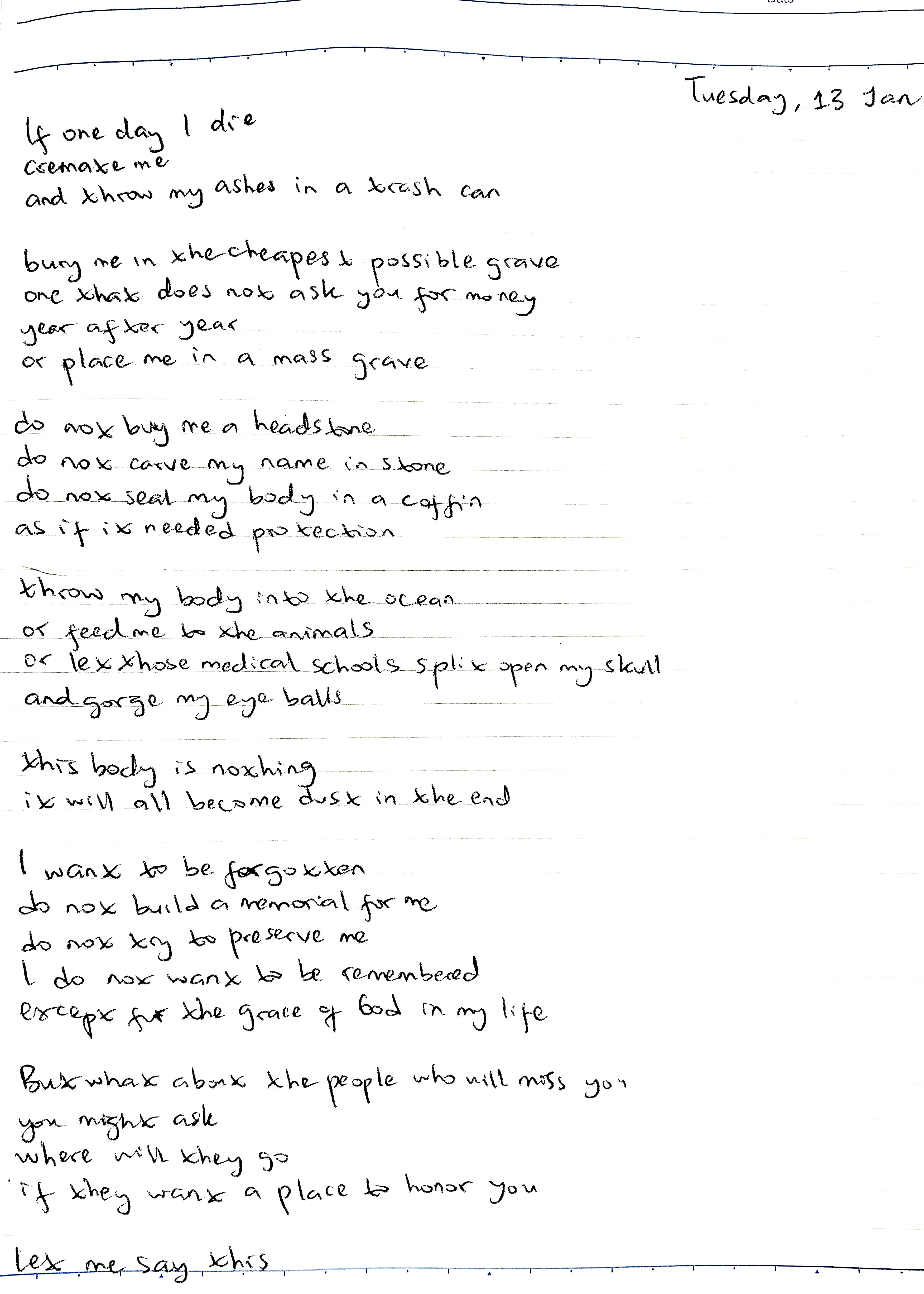
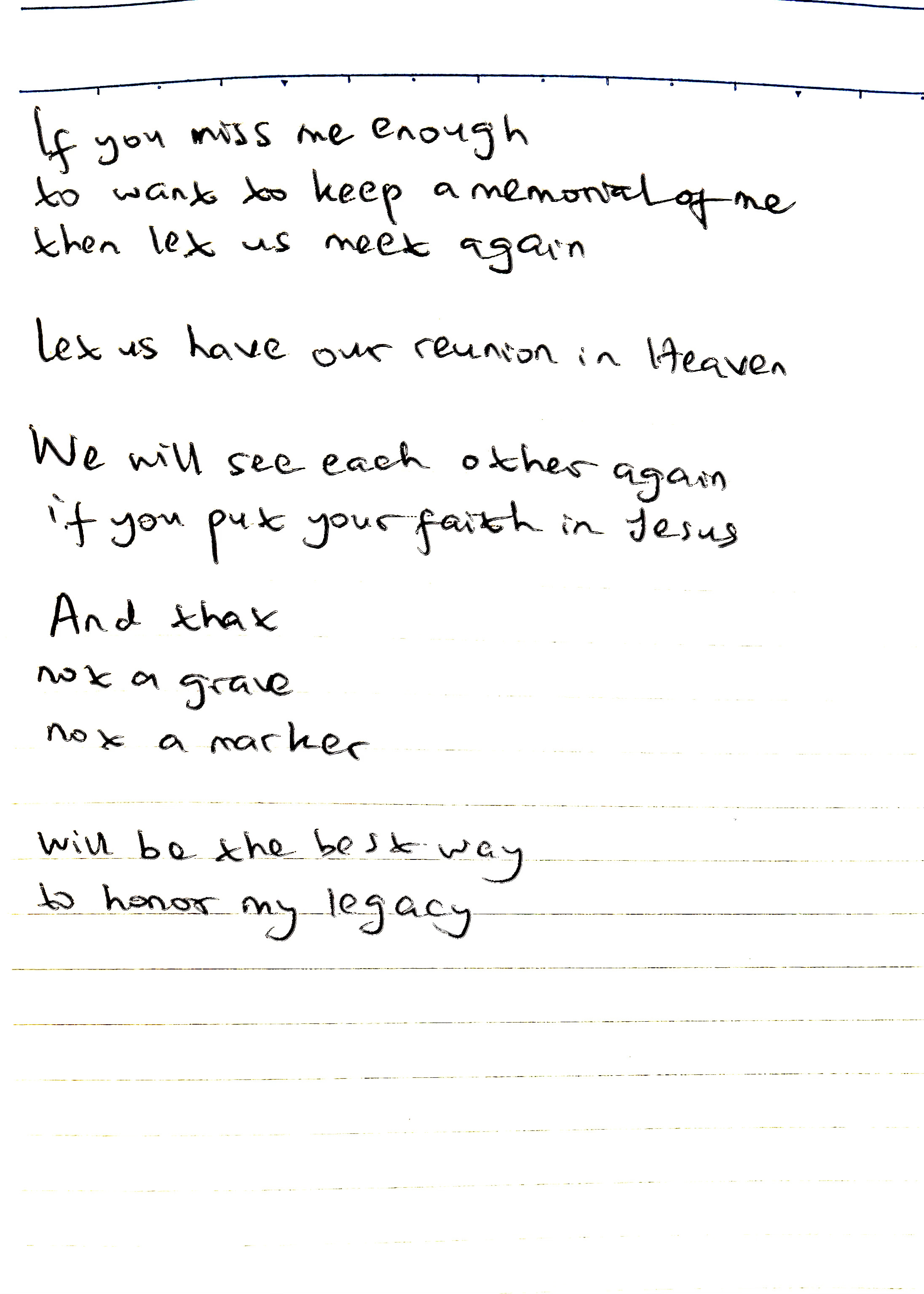
If one day I die, cremate me and throw my ashes in a trash can. Bury me in the cheapest possible grave, one that does not ask you for money year after year, or place me in a mass grave. Do not buy me a headstone. Do not carve my name in a stone. Do not seal my body in a coffin as if it needed protection. Throw my body into the ocean, or feed me to the animals, or let those medical schools split open my skull and gorge my eyeballs. This body is nothing; it will all become dust in the end. I want to be forgotten. Do not build a memorial for me. Do not try to preserve me. I do not want to be remembered, except for the grace of God in my life.
But what about the people who will miss you, you might ask. Where will they go if they want a place to honor you?
Let me say this.
If you miss me enough to want to keep a memorial of me, then let us meet again.
Let us have our reunion in Heaven. We will see each other again if you put your faith in Jesus.
And that, not a grave, not a marker, will be the best way to honor my legacy.
-
Three Circles Gospel Presentation
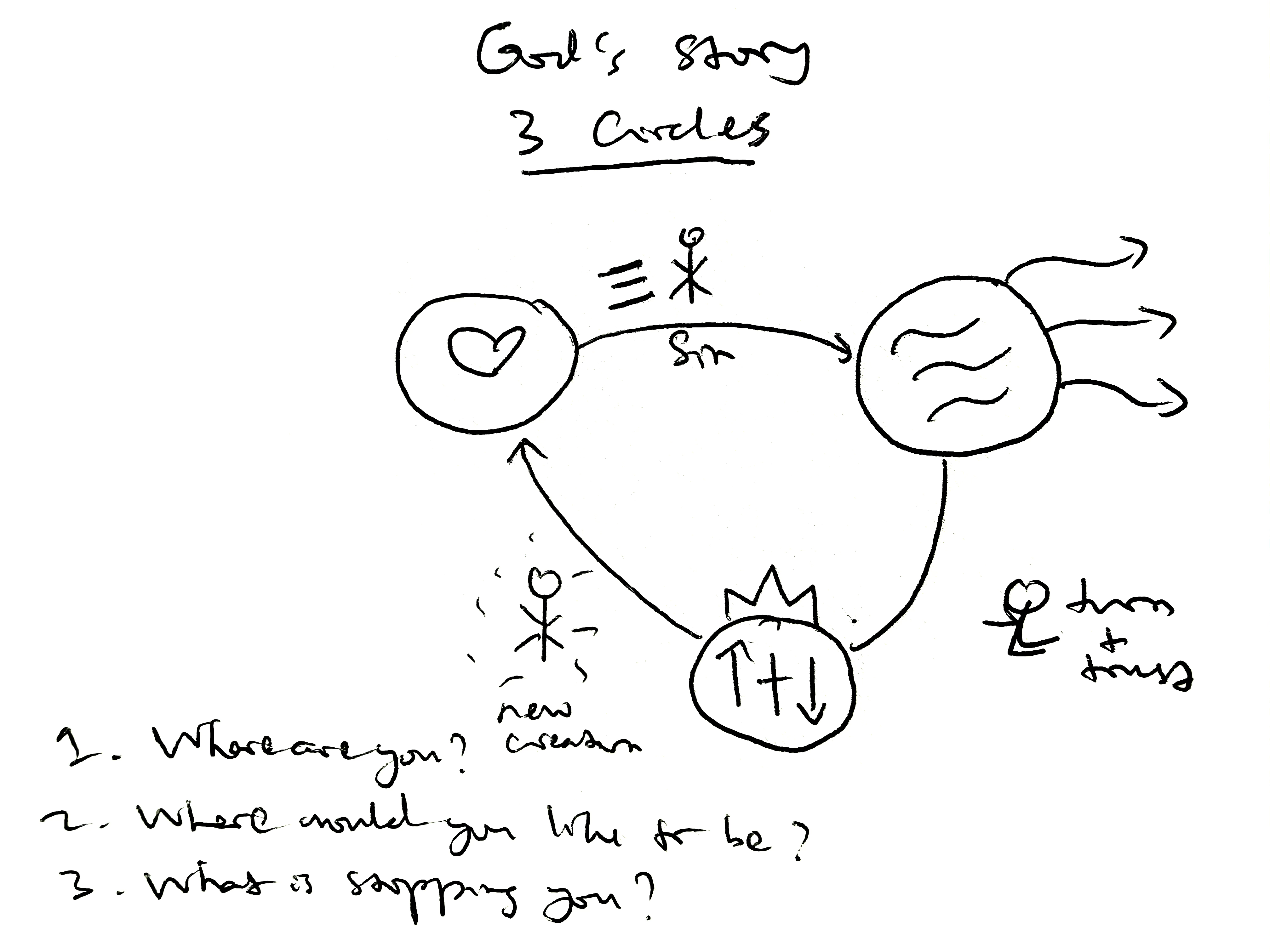
For the past two consecutive Saturdays, I have been learning how to share the hope that I have in Christ. Last Saturday, I participated in Send Saturday, organized by Church of the City in Manhattan. Today, I joined a half-day training led by Live Second Labs.
You might wonder, why am I doing this?
2 Corinthians 5:17–20 says:
Therefore, if anyone is in Christ, he is a new creation. The old has passed away; behold, the new has come. All this is from God, who through Christ reconciled us to himself and gave us the ministry of reconciliation; that is, in Christ God was reconciling the world to himself, not counting their trespasses against them, and entrusting to us the message of reconciliation. Therefore, we are ambassadors for Christ, God making his appeal through us. We implore you on behalf of Christ, be reconciled to God.
I am a new creation, and I am an ambassador of Christ. And what does an ambassador do? I’ll let you answer.
The Three Circles Gospel presentation uses three circles to tell the story of the gospel. The first circle represents the good world without sin that God originally created. The second represents the broken world we live in because of sin. The third represents God’s rescue plan: sending His Son, Jesus, into the world to redeem us from our sins through His substitutionary death on the cross and His resurrection three days later.
But how do all these circles connect with one another?
That was exactly what we practiced during part of the training. We went over the story again and again, hoping to be able to tell it clearly. Christians may know this story by heart, but communicating it in a way that someone who has never heard it before can understand surely takes wisdom.
Here is how I would tell the story:
If we look around us, we see so much brokenness in the world: disease, crime, poverty, broken families, and even war. But that is not how God originally designed the world.
In the beginning, God, the Creator, made the world good and without sin. He then created us, human beings, and we had a close relationship with Him. However, humanity chose to disobey and sin against God. Here, sin is anything we think, say, or do that dishonors Him. Sin caused brokenness to enter the world, and that is why we see what we see around us today.
So what do we do to escape this brokenness?
Some people might pursue success, money, or relationships, hoping that these things will fulfill their lives. Others turn to religion or spirituality, trying to earn God’s favor and blessings through good works. But none of these things can ultimately rescue us from sin and the brokenness it causes.
The good news is that God loves us. He knew that we could not deal with our sin on our own, so He made a way for us to be rescued. He sent His own Son, Jesus, into the world.
Jesus lived a completely sinless life. During His lifetime, some people followed Him, while others rejected Him. He was eventually handed over to be crucified on a cross. But His death was not an accident. It was God’s plan from the beginning to rescue us from our sins.
There is nothing good enough that we could do to pay for our own sins, and we deserve the judgment that sin brings. Thankfully, Jesus took our sins upon Himself on the cross and bore the judgment that we deserved. He died the death that our sins deserved, and through His death, He paid the penalty for our sins.
But that was not the end of the story.
Three days later, Jesus defeated death and rose from the grave. He is alive and now sits at the right hand of God, and He has been given all authority in heaven and on earth.
Jesus has paid the price for our sins, and salvation is a free gift. But we must personally receive this gift through repentance and faith. How? In the middle of our brokenness, what we need is to turn toward God, repent of our sins, believe that Jesus died and rose again, and surrender our lives to Him as Lord and King.
When we do that, God makes us a new creation. Our relationship with Him is restored, just as He intended from the beginning. And importantly, we have the hope of spending eternity with God.
That is the gospel.
And that is literally the story that saved my life.
-
We Want Revival in NYC
In August, I got to visit Dallas and check out the UPPERROOM prayer room. I was encouraged to learn that they have continuous live worship from as early as 6 in the morning until 8 PM, Monday through Friday, and on Saturdays too, although for a shorter time.
I remember taking a morning and afternoon off from sightseeing one Monday just to soak in the presence of God at UPPERROOM. I remember thinking to myself, “If I lived in Dallas, I would probably be here almost every day.”
I even told God how much I longed to have something like this where I lived, or perhaps for Him to move me to Dallas. Three weeks later, I found myself moving to New York City instead.
I recently officially called Church of the City home. They have prayer sets Monday through Friday at 6 AM, 7 AM, 12 PM, and 7 PM, except for Wednesday evening. Today, I went to their prayer room at noon for the first time.
As I sat there, I thought back to that prayer I had prayed in Dallas.
I am deeply encouraged to be surrounded by New Yorkers who are hungry for God and who are faithfully praying for this city. And I am grateful that God has led me to a church that makes both individual and corporate prayer a priority.
Here’s a quote from David Fritch:
“Don’t despise your small prayer gatherings… Every major revival has its origins with a small band of intercessors faithfully crying out! Small gatherings precede big breakthroughs! When we gather to worship and pray, regardless of size, we convene the very court of heaven on earth. Our prayer gatherings are the most important and powerful gatherings in our city.”
I stand in agreement that every revival begins with a prayer movement. I moved to NYC just a month and a half ago, and I am still learning about what God has been doing in this city and what role He might allow me to play in it. One of my favorite prayers is simply asking God to consider me for His work.
Whatever that role may be, no matter how insignificant or mundane, I would be grateful if God chose to use me in any way. And so, we will keep praying for NYC. I pray that God would awaken more and more of His people here to intercede for this city.
O God, we want revival.
Let it stir!
And pssst… I also somehow ended up in their IG post (2nd and 3rd slide) :D
-
The Goal Is to Love God
Today, I was listening to a sermon on biblical courtship by Paul Washer titled The Parent’s Responsibility in the Home. Please don’t tease me, y’all. I prayerfully want a family in the future, and as a follower of Christ, I think it’s important for me to deepen my understanding of these things.
There was one statement he made that really struck me:
“I don’t want to take anything away from all these things of just defining exactly what is the will of God, and how do we do this, and how do we do that, and how should we practice courtship, and what should marriage be like, and how should you discipline children, and all of that is very, very good. But if you get all that kind of stuff without the big thing, you’ve missed the whole picture and you’ve just become a bunch of sad Pharisees. You don’t want that. The goal is to love the Lord your God with all your heart, soul, mind and strength.”
I could really relate to that. There was a season in my life when I was overcomplicating and obsessing over God’s will for my life. I was constantly asking myself whether what I was doing, and even how I was doing it, was what He wanted me to do.
But over time, I learned something important: when I become too fixated on figuring out God’s will and getting every little detail right, it is easy to lose sight of the bigger picture. Seeking His will and living in obedience matter, but I believe they should flow from loving God with all my heart, soul, mind, and strength (Matt. 22:37), not out of fear of missing “the one perfect path.”
That realization has even changed how I approach my day-to-day life. I have come to understand that my biggest priority, every day of my life, is to seek first the Kingdom of God and His righteousness (Matt. 6:33), fixing my eyes on Jesus (Heb. 12:2). I trust that as I seek Him, I will know Him more. And the more I know Him, the more I love Him.
And again, this is the part I want to keep coming back to: the goal is to love God with all my heart, mind, soul, and strength. Everything else will follow.
That’s it.
-
Not Striving
Today, I went to my Church of the City small group, where we discussed last week’s sermon on the fruit of the Spirit (Galatians 5:13–26).
Galatians 5:22–23 says:
“But the fruit of the Spirit is love, joy, peace, patience, kindness, goodness, faithfulness, gentleness, self-control; against such things there is no law.”
One of the discussion questions was:
“The fruit of the Spirit is produced through union, not imitation; by beholding, not striving; and in community, not isolation. Which of these ideas challenges or encourages you most?”
I was particularly intrigued by the idea of not striving. It made me think about how easy it is to approach the Christian life as if it were a matter of performing better. Like, I need to try harder to be more loving, more joyful, more peaceful, and so on. However, I have learned that those “fruits” are produced through inner transformation, through the work of the Holy Spirit in me, and are not the outcome of my own effort.
Romans 12:2 says:
“Do not be conformed to this world, but be transformed by the renewal of your mind, that by testing you may discern what is the will of God, what is good and acceptable and perfect.”
The Scripture is clear enough that I am the person to be transformed, and not the person causing the transformation. God is the one who renews my mind.
And what leads to this inner transformation? From previous sermons, I learned that it is through abiding in God. It means that, like a branch connected to the vine, which is Christ, I bear fruit because I remain in Him. Being gentle, faithful, and good are not things I have to manufacture on my own. They are the natural consequences of remaining in God.
I watched a sermon a while ago by Pastor Peter Tan-Chi, and he said something that has stayed with me:
“The Christian life is not hard. It’s impossible. The Christian life is not difficult. It is supernatural.”
Let me close with a personal experience of mine. During part of my graduate studies, I had drifted away from God and found myself becoming a prodigal again. I was also struggling with a destructive habit that truly felt like bondage. Then, when I hit rock bottom early last year, I repented and turned back to God.
What happened afterward was something I couldn’t really explain. Somehow, my destructive habit no longer had the same hold on me! I no longer desired what I used to desire. Something in my heart had changed.
It wasn’t me who did the changing. God did.
I certainly tried to break that destructive habit on my own in the past, relying on my own strength, but I kept failing and failing. And now, I am completely free.
Supernatural, indeed.
-
I Will Write Every Day
Greetings from New York City!
I usually share my life updates and reflections on social media, but I’m hoping to transition out of them. I am not joking when I say that my Instagram posts and stories are already essay-like!
I’ve always loved writing, whether it’s simply typing behind a screen like what I’m doing right now, or sitting down to write an actual handwritten letter to a friend. I think slowing down and reflecting by writing down my thoughts helps me be a little more intentional about how I live.
And I’m giving myself a very ambitious goal for this blog: to write every day. Some days, it might be a longer post. Other days, it might be nothing more than a sentence or two. Let’s give it a try, shall we?